Kawasaki’s flagship Ninja H2 speed machine stands accused of being blindingly fast and astoundingly engineered. We pass judgement on the criminally desirable machine…
Many of us recall when the Ninja H2 hit the headlines in 2015 as the world’s first mass-produced supercharged motorcycle (at least since WWII, but that’s another story). It caused quite a stir, both with its whopping power output and the way all this grunt was generated. The H2’s motorcycle-specific supercharger was designed by Kawasaki engineers utilising technology from the Japanese firm’s own gas turbine and machinery and aerospace companies, as well as its corporate tech division. A supercharged litre bike featuring funky components derived from turbines and spaceships? That’s something I’m quite sure I was building from Lego back in the day… and if my inner child was excited, the adult rider was positively frothing at the mouth.
More than a decade later, the Ninja H2 is still Kawasaki’s flagship motorcycle. And it’s still making us weak at the knees, with its unique combination of futuristic styling, cutting-edge tech and sheer power. It is an incredible machine on paper and I can’t wait to have a ride. Of course, it’s raining cats and dogs on the day I ride out to Kwaka HQ to pick up the test bike. I get there on a BMW M 1000 R, which despite being a beautiful and supremely capable machine, somehow manages to look slightly ho-hum next to the H2. It gets me thinking: these bikes are similar in many ways. They are both expensive, crazy fast and beautifully engineered. However, they offer completely different riding experiences. If the BMW is a wolf in wolf’s clothing, the H2 is a werewolf in a spacesuit. It’s an insane bit of kit in so many ways, one that isn’t as all-round perfect, easy to ride or day-to-day practical as the Beemer, but which is just so outlandishly exotic and unique, its flaws are quickly forgotten.
GOOD LOOKIN’
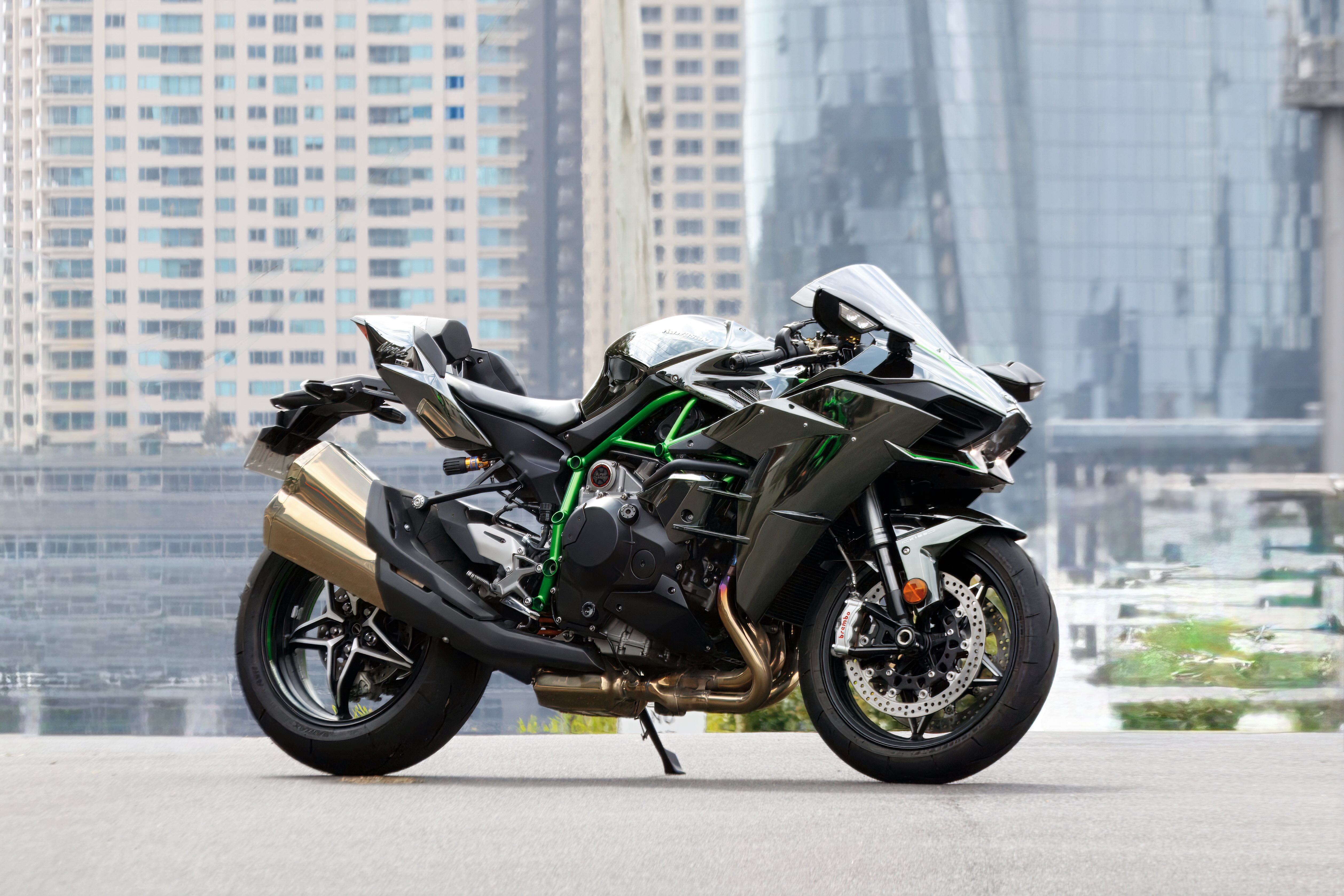
Looks are in the eye of the beholder, of course, especially when it comes to bikes. But, for mine, the Ninja H2 is the most beautiful new motorcycle on the market. What Kawasaki refers to as its “Intense Force Design” won’t be everyone’s cup of tea, but it’s the kind of bike that excites the imaginations of non-bikers with its crazy looks and bikers with its crazy specs. I reckon you could put it in a museum to illustrate the cutting edge of production motorcycle engineering in the 21st century. But that’s not my present concern; I’m busy trying to find Rain mode before I ride this beast home. I wouldn’t be too concerned with this on a “normal” bike, and was actually quite happy riding the M 1000 R in the rain in Road mode a few moments ago. That might sound a bit silly on a 200+hp bike, but the BMW delivers that power in a very different way to the H2. Trust me, you do not want to be twisting the throttle too eagerly when exiting a wet roundabout on a 240hp supercharged two-wheeler.
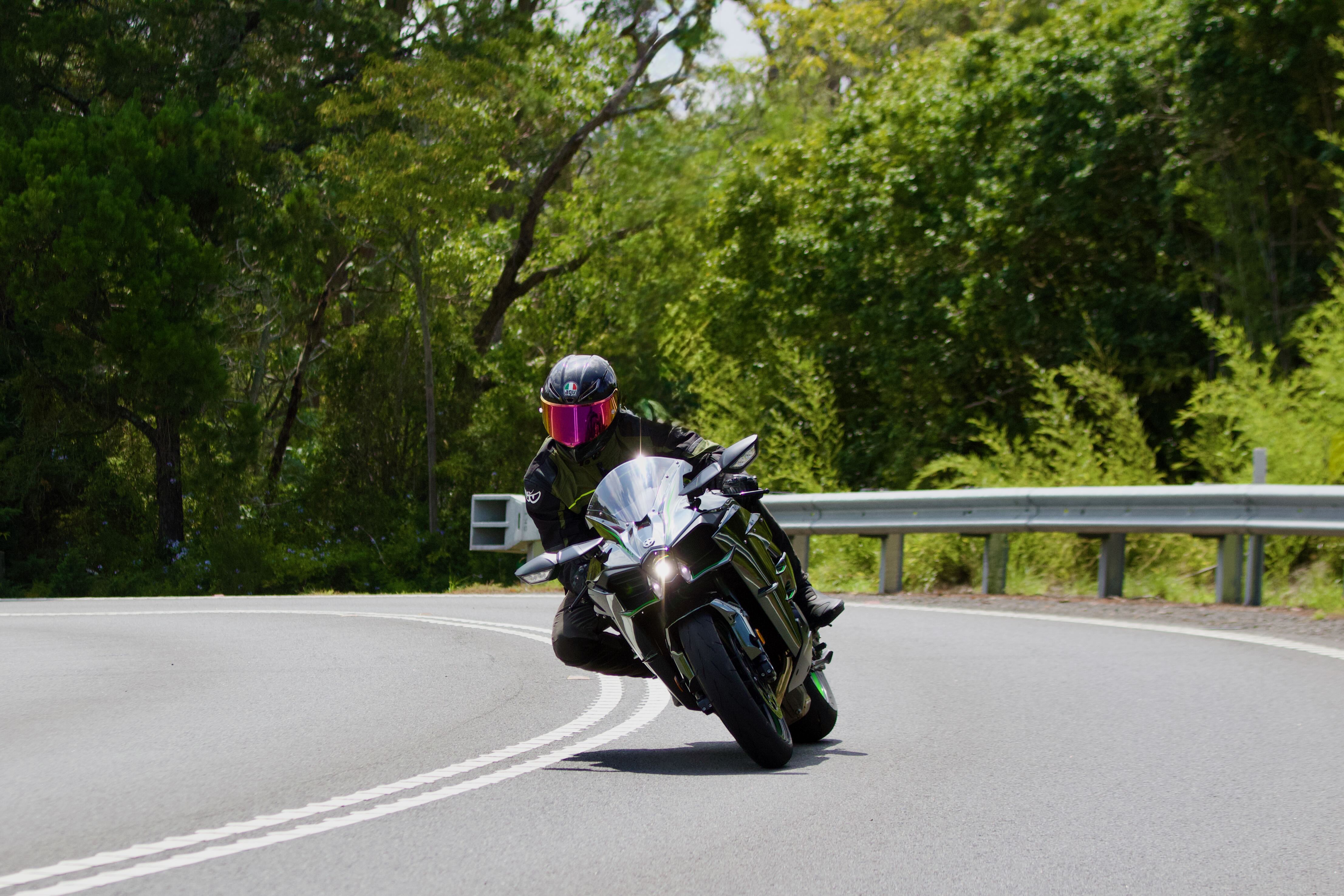
Once I’ve worked that out, I take some time to look over the H2, primarily because it has been nicely detailed and sadly is about to get covered in road grime. There are two things that stand out, cosmetically speaking. First up is the paint job. Pictures don’t do justice to the incredible “silver-mirror” or paint specially developed for this bike. The “Mirror Coated Matte Spark Black” model is the only one on offer, and I can see why. It looks perfect. The other is the bike’s stance; the Ninja H2 does not have the aggressive forward-leaning aspect of most modern sportsbikes. Kawasaki says that, at the speeds for which the H2’s closed-course-only H2R sibling (see “You want more?” box) was designed, “such a posture would create drag that would hinder top speed aspirations”. Instead, its stance is very neutral — almost flat like a Formula 1 car — to make the body as sleek and slick as possible. Assistance from Kawasaki’s aerospace company was enlisted in creating the bodywork to ensure maximum aerodynamic efficiency. The upper cowl, for example, uses lips and lines to help direct airflow over its surface, positions the Ram Air intake in the most efficient position, and incorporates a chin spoiler that creates considerable downforce. And the centre portion of the rear cowl is taller, which helps smooth airflow as it passes the rider. Wind is also able to pass between the centre and side pieces, reducing air resistance. The resulting silhouette reminds me of a big bull shark, gently sloping at the front of its solid, rocketlike body. And, just like this apex predator, the H2 looks beautiful, dangerous and fast — there’s no turning away from either of them and they both demand our respect.
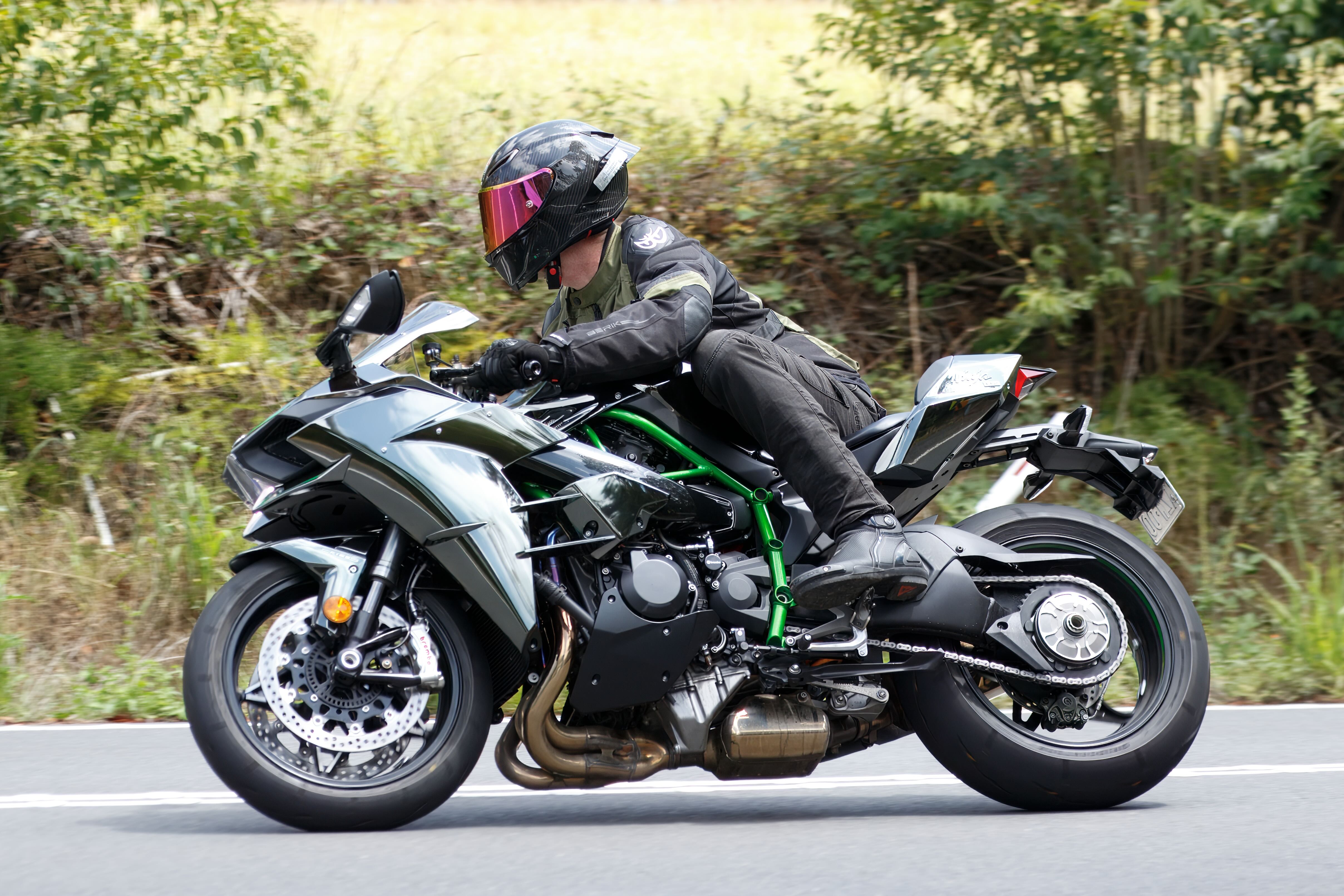
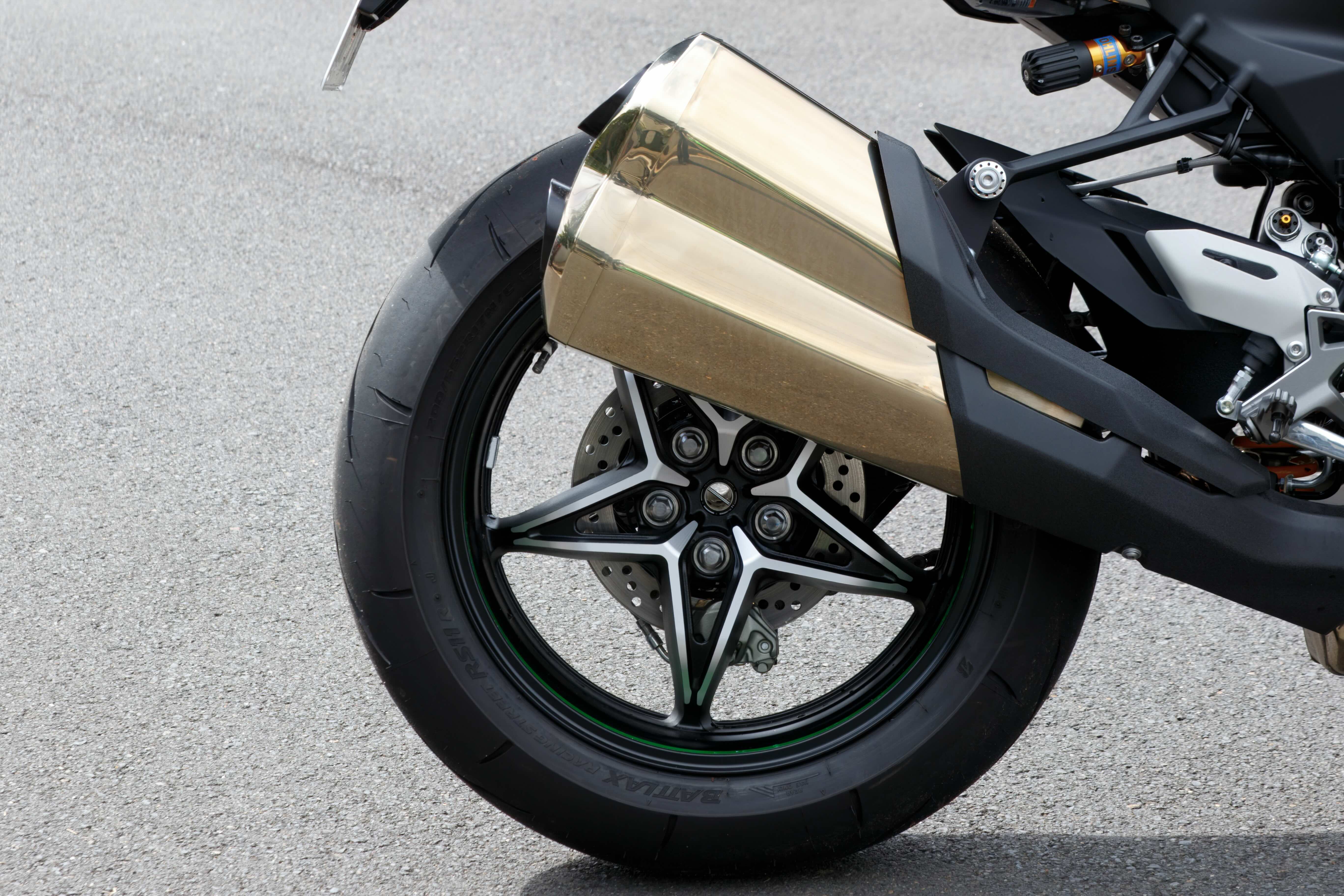
The engineering quality of the Ninja H2 is also undeniable. There’s the gorgeous green trellis frame made primarily from high-tensile steel, welded both by Kawasaki robots and actual humans. The H2 also features Kawasaki’s first single-sided swingarm, which allows the massive exhaust silencer (thanks Euro 4) to be mounted closer to the bike centreline, creating a higher bank angle. You can see that the metalworking, treatment, welding, painting and so on have been conducted at a higher level than your average mass-production model. Machined surfaces on the cast-aluminium wheel spokes and painted rims, for example, as well as machined bolt and nut designs on the steering stem and rear hub nuts. Apparently there’s a space in Kawasaki’s Akashi factory dedicated to the production of Ninja H2s. It shows in both the bike’s build quality and its almost $50K price tag.
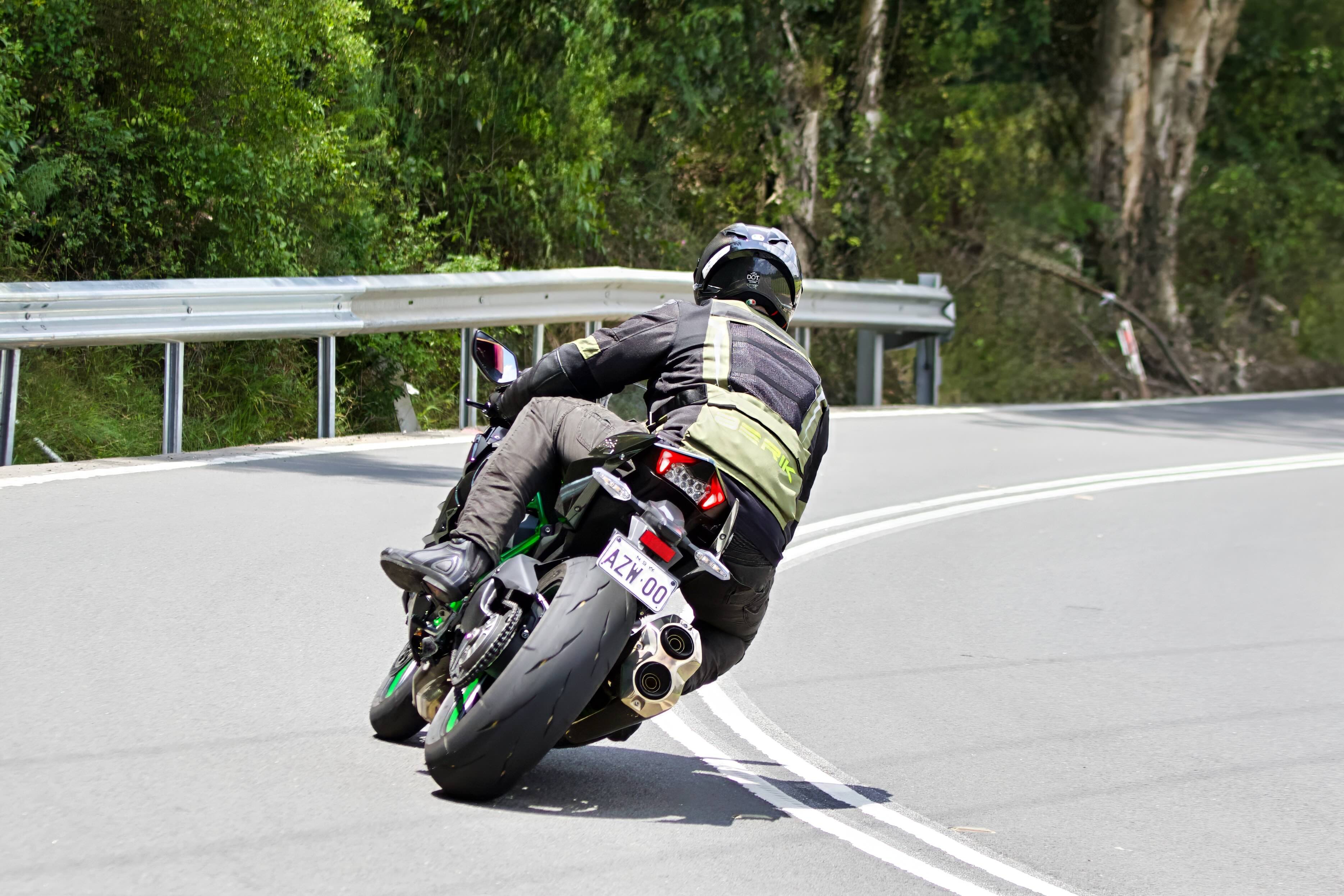
When parked next to the M 1000 R, it strikes me that there are no big wings sticking out of the H2 to keep the front wheel on the ground when all that power is delivered to the rear wheel. Interestingly, there are aerodynamic winglets on the track-only H2R, but some digging uncovers why the H2 doesn’t need them — the mirrors are its wings! The mirror stays (obviously not needed on the track-only bike) feature airfoil cross-sections also designed by the aerospace boffins. Their trailing edges are equipped with Gurney flaps that increase the effectiveness of the simple airfoil shape, allowing greater downforce to be generated with a smaller surface. Considering their aerodynamic role, I expect the mirrors to be useless for actual vision duties. Imagine my surprise when I discover that they are some of the best in the business. Easy adjustment, perfect position and no blurring whatsoever. Impressive!
IT’S THE DETAILS
Okay, so now that I’ve had an eyeful, it’s time to get this thing home in one piece. I’ve employed Rain mode (signified by a little umbrella light on the edge of the tacho), which selects full traction control and limits power output, torque and response. The heavens open and I’m soon riding in a downpour, but the H2 is surefooted and stable. Sure, it has a relatively aggressive riding position, but nothing too crazy (it’s more relaxed than the Ninja ZX-10R, for example). And the screen isn’t much use for weather protection, especially for a taller rider. But the bike behaves itself in the wet and the Bridgestone RS11s are much better than one might expect on slippery tarmac. I arrive home on a very wet and dirty bike, with a big streak of oil and dirt up the back of my jacket. To be honest, I doubt that any of that will be a problem for potential owners, as most H2s are only likely to be wheeled out on a sunny day for a country squirt. But it’s nice to know that if you are caught in a storm, you will not have a dangerous handful to contend with.
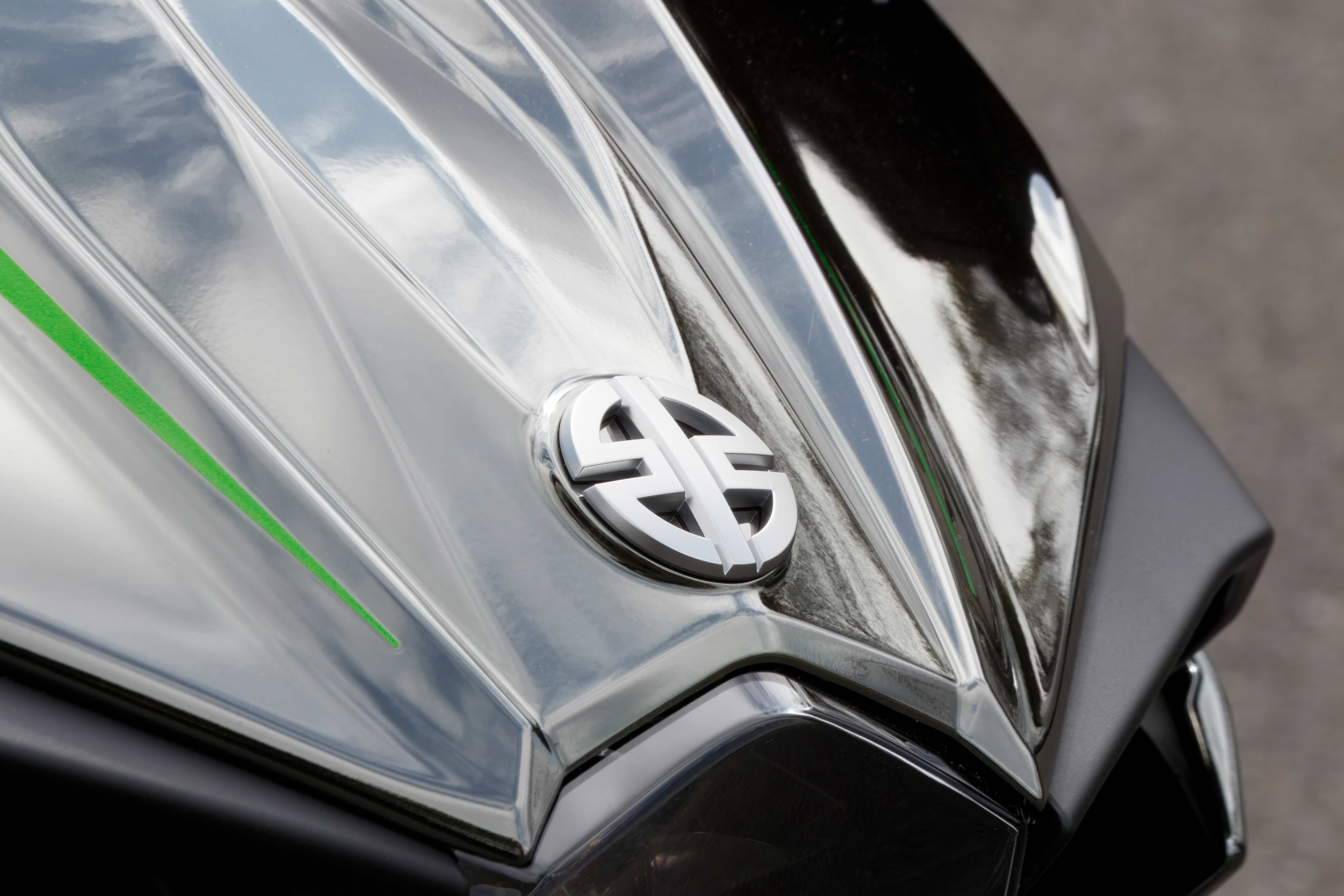
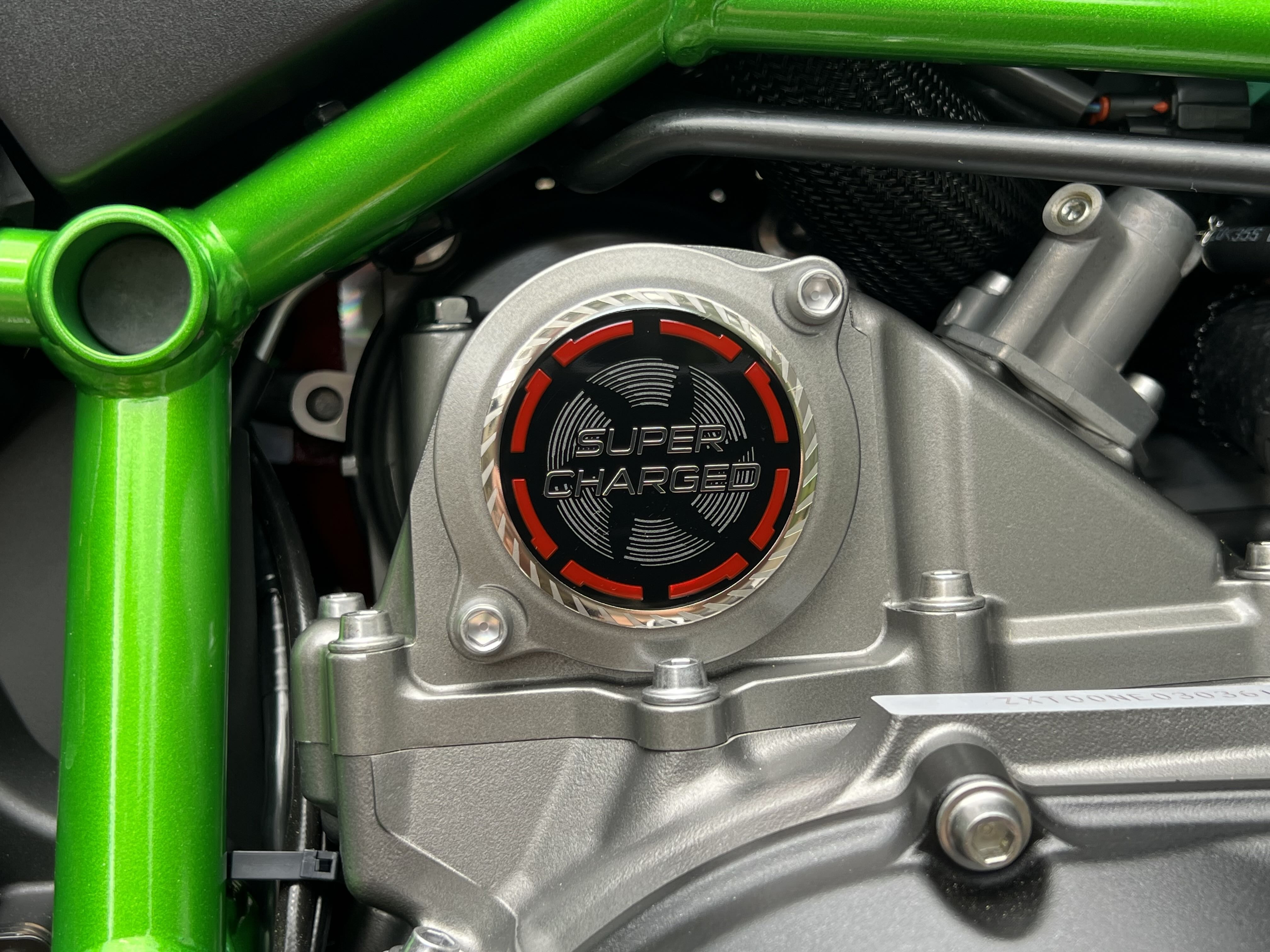
Later on, I give the bike a quick tub in anticipation of what is forecast to be a rain-free day. I discover that the mirror paint is simple to clean and keep that way with a bit of silicone spray or similar. Like some other Kawasaki models, it has the company’s own “Highly Durable” paint, which features a special coat that allows small scratches to repair themselves, with soft and hard segments in the coat working together like a chemical spring to absorb impacts. Of course it has its limits, but it’s a nice touch for a special bike that owners will want to keep looking schmick. The badging is also special. The “supercharged” emblem depicting high-velocity intake air being spun around is a nice touch, as is the Kawasaki River Mark on the bike’s snout. This symbol of the Kawasaki Heavy Industries Group dating back to the 1870s is used on this model due to the inter-company collaboration (and fans of the marque will know that it is only used on models of historical significance).
You get the drift — the Ninja H2 is special… and I haven’t even mentioned its pièce de résistance yet! That’d be the almost 240hp supercharged 998cc inline four-cylinder engine based closely on that developed for the 322hp closed-course Ninja H2R. Aside from minor differences in the engine unit (camshafts, head gaskets and clutch), and intake and exhaust systems tailored for street use to ensure it meets noise and emissions standards, the engine is essentially the same in both bikes. Of course, it has been designed to accommodate the higher air pressure and high-temperature exhaust gases of a supercharged system. The motorcycle-specific supercharger itself is a centrifugal-type unit with a cast-aluminium housing located behind the cylinder bank. It doesn’t need an intercooler and it uses engine oil for lubrication, both factors keeping it compact and light, which is of course ideal for use on a bike. It is driven by a planetary gear train that runs off the crankshaft, which increases the impeller speed to 9.2 times the crank speed. This means that at 14,000rpm, the impeller shaft is spinning at around a mind-boggling 130,000rpm. The 69mm aluminium impeller features six blades at the tip, expanding to 12 blades at the base and its pumping capacity is more than 200 litres/second, with intake air reaching speeds of up to 100m/s. This is all to say that the supercharger spins blisteringly fast and force-feeds the engine a bucketload of fresh air, which enters via a single Ram Air intake in the left side of the upper cowl.
It’s worth noting that the H2’s engine’s claimed maximum power of 170kW (228hp) at 11,500rpm is what you’d hope to measure on a dyno. To get the claimed maximum power with “Ram Air” — listed as 178.5kW (239hp) — you’d need the bike itself to be moving very fast (or perhaps being tested on a dyno in an air tunnel), thereby feeding more air into the system. The H2 has a wet weight of 238kg, so you can see that we’re hovering around the magic 1:1 power-to-weight ratio. In any case, with figures this high, how much exact power it produces is purely academic for anyone riding it on the road… and for 99.9 per cent of us on the track. And if you do want more on track, there’s always the H2R.
RIDING EXPERIENCE
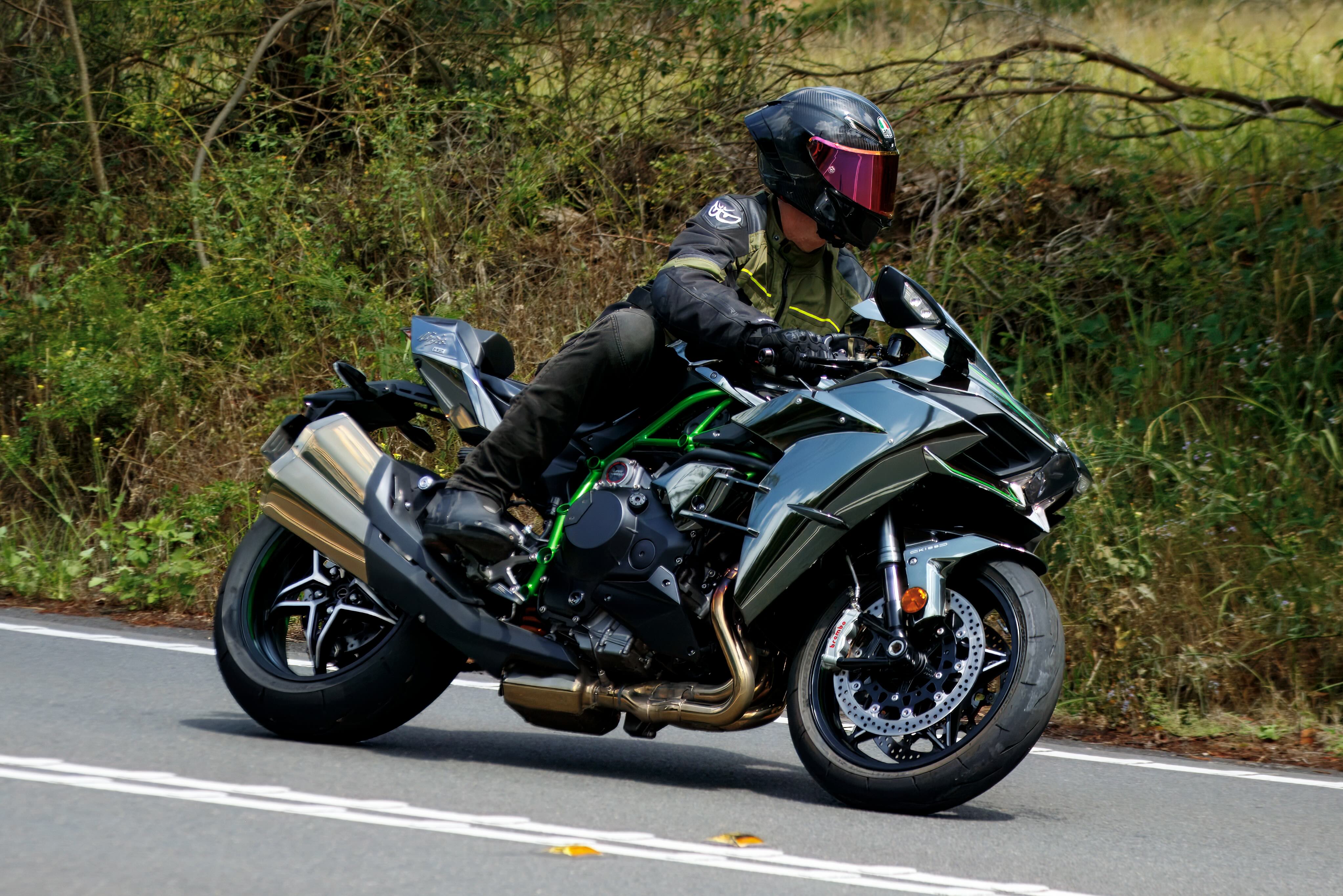
So, how does it all feel to ride? Absolutely amazing! Addictive. Adrenaline-pumping. An avalanche of awesomeness. And all the other A words. It’s an absolute missile in any gear at any revs. It just takes off and keeps going. For everyday riding duties, I find that cruising at around 4250rpm in second gear gives me a comfortable 60km/h, the same revs in fourth, 80km/h, and again in sixth, 110/km/h. It’s a sweet spot that allows some reduction of revs without becoming snatchy, but which also puts you in prime position to crack the throttle and feel that supercharged power surge in. The acceleration is both brutal and uninterrupted and can get you into a lot of trouble very quickly. It just builds and builds to redline, with the supercharger tweeting like the angriest of birds, until your brain feels like it’s being sucked into a black hole and spat out into another galaxy. Exhaust noise is relatively muted, thanks to the massive silencer, which of course could be altered with an aftermarket system. However, for mine, the soundscape created in the cockpit of the engine components and supercharger doing their things is sublime enough.
All that power is transferred to the rear wheel courtesy of a dog-ring type transmission, developed with assistance from the Kawasaki Racing Team. Changes are smooth and precise with the two-way quickshifter, as long as you avoid changing at very low revs, which the bike simply refuses to allow. I had been warned to expect a heavy clutch on the H2, but Kawasaki says the current model has 40 per cent lighter clutch lever feel than the previous one. I reckon the latest hydraulic assist and slipper clutch actually feels just about right for a big bike. The clutch adjustment on the test bike feels a little off, with the bite point too far out and then rather instantaneous, but the action itself is light and smooth. I notice that with aggressive downshifting, the slipper cam can be felt stopping any excessive back-torque from making the rear tyre hop and skid, which is useful on such a powerful bike. Brembo parts are used for both the clutch lever’s radial-pump master cylinder and the clutch release mechanism, and aluminium clutch hub material saves about a kilo compared to a steel unit.
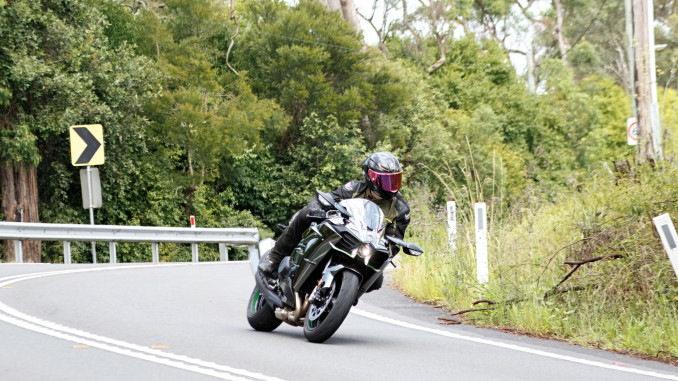
Handling is sharp, especially for a 238kg bike, partially thanks to the relatively short 1455mm wheelbase and also to top-notch suspension. There’s fully adjustable KYB AOS-II racing suspension up front, which I have to say is silky smooth and stable under heavy braking, in particular. At the rear is an Öhlins TTX36 shock rear shock mounted to the swingarm mounting plate. Compression and rebound damping are each 22-way adjustable and it also has a handy remote preload adjuster. At this price point, you might expect semi-active suspension, and I might be inclined to agree with you. It would definitely come in handy on those choppier stretches of road. But the fact remains that the suspension componentry is top tier and infinitely tweakable, and its performance is excellent under most conditions. The Öhlins electronic steering damper is a reassuring addition to a bike capable of very high speeds. It uses input from the rear wheel speed sensor (provided via the engine ECU) to determine what it needs to add to the setup at any given time.
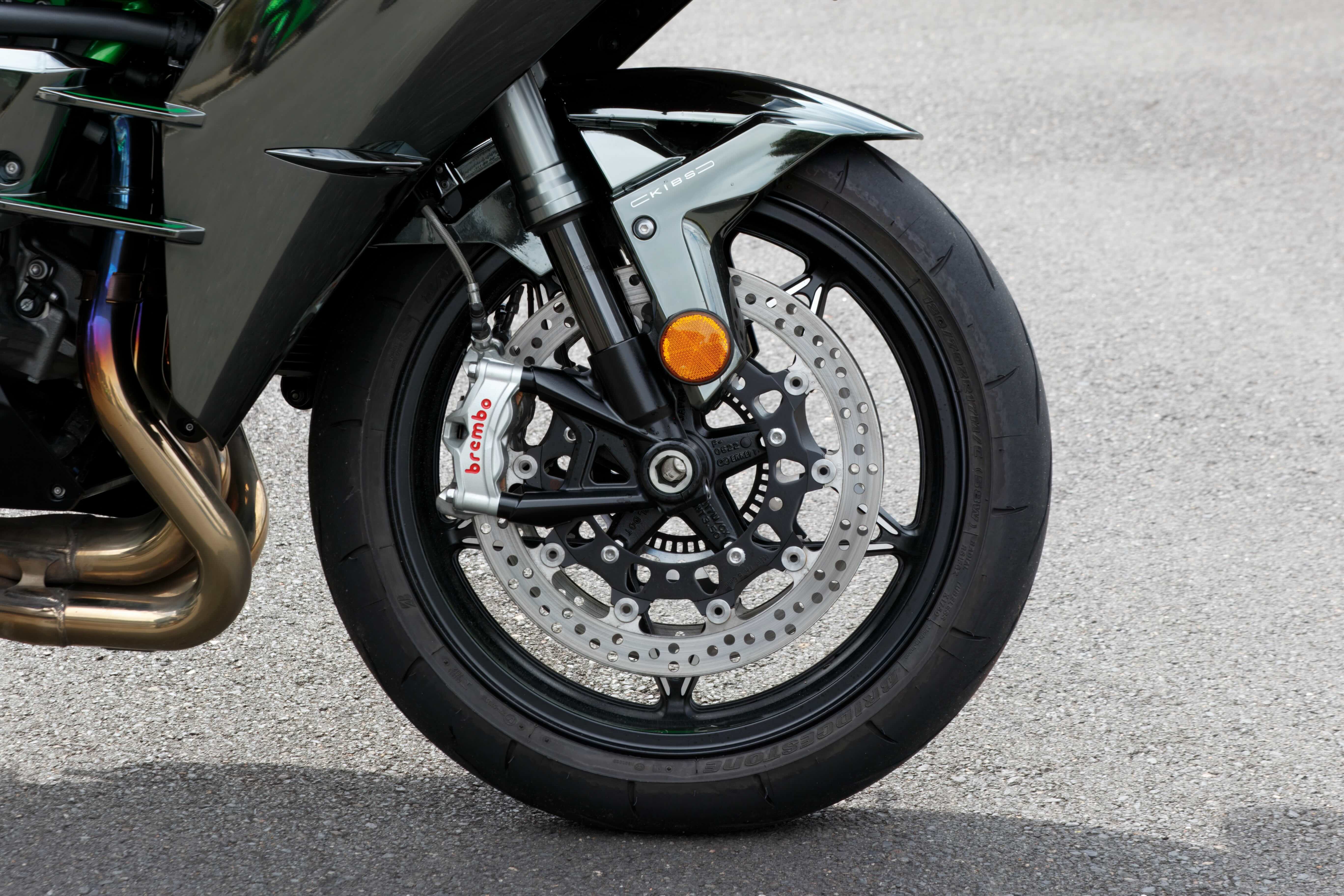
Rapid deceleration comes courtesy of Brembo M50 monoblock calipers gripping 330mm discs up front, and a single 250mm disc with a two-piston caliper at the rear. This is Kawasaki’s first use of Stylema calipers, which have less volume around the pistons and brake pads than previous M50 units. This reduces the internal space taken up by brake fluid, enabling a more direct response. They are also lighter and able to stay cooler for longer. The resulting braking power is nothing short of phenomenal, even with very abrupt application, while lever feel and control at city speeds is perfect. An absolutely top-draw system that is well matched to the bike, no doubt about it.
TECH STUFF
I could go on for ages about the electronics that operate in the Ninja H2, but I’ll spare you too much tech talk. Suffice to say that, if you buy one from a dealer, they’ll run through the bike and show you how to switch features on and off from the factory settings, which are: quickshifter off; rev limit indicator at 4000rpm; engine braking off; and KTRC (including traction, wheelie and sliding control) set at level 5. I’d be switching on that quickshifter, bumping up the rev limit indicator, adding a little engine braking and leaving the traction control at 5, which is right in the middle of intrusive and invisible. This all matters because there are no pre-set riding modes on the H2 besides Rain mode. It’s just full power after that, so you do want to ensure all the electronics systems are functioning the way you want and expect them to. These include lean-sensitive anti-lock braking, lean-sensitive traction control, engine-brake control, cornering-management function and launch control.
The status of these systems is easily viewed on the full-colour TFT LCD screen, which enables some information to be displayed graphically on a choice of black or white backgrounds. Four selectable display modes give you all the usual info, plus nice touches such as bank angle, boost indicator, intake air chamber temperature, and throttle and brake force application. A large analogue-style tachometer sits beside the screen, which is a visual setup that I really like. Surrounding the tacho are the usual engine, oil and battery warning indicators, plus turning signals and lights that show the employment of Rain mode, traction control, ABS and so on. More information is also available via the obligatory smartphone application. This includes riding logs and vehicle running information. Unfortunately, there’s no fuel gauge on either bike or app, only a low-fuel warning light that comes on when there is about 3.5 litres left in the 17-litre tank. So, given our tested fuel consumption figure of 6.9 litres per 100km, you’ll be looking for a fuel stop well before 240km.
You’ll also be wanting a body stretch break after a couple of hundred kays, I’d warrant. Not that rider comfort isn’t good, because it is. I feel quite at home on the wide (albeit thinly padded) seat, which features supporting pads at the rear of the seat that are adjustable by 15mm to suit rider size. The screen doesn’t do much more than direct wind onto my helmet unless I tuck in under it, but this is not a touring bike and I am a tall guy. There’s plenty of legroom, so the hips don’t cop a battering, but it can be a little hard on the wrists over long distances or in heavy traffic. That’s my cue to have a whinge about manufacturers not putting cruise control on big expensive bikes. The Ninja H2 could use it to allow you to get the blood circulating back in your hands, not to mention keeping to the speed limit in camera-strewn tunnels. This bike is an absolute licence loser because, not only can it go ridiculously fast, it does so with such ease that you can easily drift up to jail-time speeds on the highway if you’re not keeping your eye on the speedo. OK, rant over.
Priced from $49,939 (ride away), the Kawasaki Ninja H2 ain’t cheap. Add the aftermarket carbon cowling and it’s closer to $57K. But I would argue that if you are after something very special to own, ride and probably stare at for hours in the garage, it’s hard to beat. It’s a beautifully built and impeccably designed piece of motorcycle art which, while not for everyone or for everyday use, is certainly in no way too exotic or hard to handle for an experienced rider. I am glad that Kawasaki decided to create this unique supercharged bike a decade ago and that it continues to refine it and build new models.
Photos: Dean Mellor
JUST COOL IT!
The Ninja H2’s compact side and under cowls are designed to assist with heat dissipation (as is the open trellis frame), and believe me there’s a lot of heat to be dissipated. It is not a bike you want to be sitting on for any length of time in summer traffic. It won’t overheat or start performing poorly, but you might. Saying that, it’s nothing that will bother you during normal open-road riding.
Maximising cooling efficiency was a key consideration when designing the H2’s engine. In addition to ensuring that intake air remains as cool as possible, the heat generated by the high-output engine needs to be dissipated and engine components themselves need to be kept cool to ensure efficient operation. This necessitates a highly complex engine layout, both for the lubrication system (oil is used for cooling as well as lubrication) and the cooling system.
A number of considerations were given to the cylinder head design to ensure the cooling performance needed for the supercharged engine. A water jacket extending between the twin exhaust ports of each cylinder, and large coolant passageways around the spark plug holes and the valve seat areas, are prime examples. There are two oil jets per cylinder to ensure the hot pistons are effectively cooled. Oil jets also lubricate the supercharger chain at the two contact points (where the chain meets the upper and lower gears). Transmission oil jets (first used in a Kawasaki motorcycle on the 2015 Ninja H2/ H2R) also enable the bike to run a compact transmission with high durability.
Because the lubrication system is servicing so many components, oil volume is five litres — about 35 per cent greater than that usually seen in an engine of the same displacement. A liquid-cooled oil cooler adds to the high cooling performance necessary for this engine.
YOU WANT MORE?
If you fancy an H2 with a low-fat body but a full-cream engine, you could go for the 216kg, 322hp H2R. The catch? You can only ride it on a racetrack… and it costs $76,386 (ride away). No lights and mirrors, full titanium exhaust system and carbon bodywork keep the weight down, while claimed maximum power is 228kW (306hp) @ 11,500rpm (240kW/322hp with Ram Air) and claimed maximum torque 165Nm @ 12,500rpm. Insane figures!
SDPECIFICATIONS
ENGINE
Type: Four-cylinder, DOHC, 16 valves
Capacity: 998cc
Compression ratio: 8.5:1
Engine management: Fuel injection: ø50mm x four with dual injection and supercharge
PERFORMANCE
Claimed maximum power: 170kW (228hp) @ 11,500rpm (178.5kW / 239hp with Ram Air)
Claimed maximum torque: 141.7Nm @ 11,000rpm
Fuel consumption: 6.9L/100km (as tested)
TRANSMISSION
Type: Six-speed dog-ring
Final drive: Chain
Clutch: Wet multi-disc hydraulic assist and slippe
CHASSIS AND RUNNING GEAR
Chassis: Trellis, high-tensile steel frame with swingarm mounting plate
Front suspension: 43mm inverted fork with rebound and compression damping and spring preload adjustability, and top-out springs, 120mm travel
Rear suspension: Gas-charged shock with piggyback reservoir, compression and rebound damping, spring preload adjustability, and top-out spring, 135mm travel
Front brakes: Dual semi-floating 330mm floating discs, four-piston calipers
Rear brakes: Single 250mm disc, two-piston calipe
Tyres: F: 120/70ZR17 Bridgestone Battlax Racing Street RS11; R: 200/55ZR17 Bridgestone Battlax Racing Street RS11
DIMENSIONS AND CAPACITIES
Caster (rake angle): 24.5°
Steering angle (left/right): 27°/27°
Trail: 103mm
Claimed weight (wet): 238kg
Seat height: 825mm
Wheelbase: 1455mm
Fuel capacity: 17L
ELECTRONICS, RIDER AIDS & CONVENIENCE FEATURES
Cornering management function, traction, wheelie and sliding control, launch control, anti-lock brake system, engine-brake control, two-way quickshifter, Öhlins electronic steering damper, full-colour TFT LCD screen with analogue-style tachometer, all-LED lighting, and smartphone connectivity
ETCETERA
Price: The Kawasaki Ninja H2 is priced from $49,939 (ride away). The model tested had a $46.45 tank pad fitted to it. This gives it a total ride away price of $49,985.45.
URL: https://www.kawasaki.com.au/en-au/motorcycle/ninja/hypersport/ninja-h2
Warranty: Two years, unlimited kilometres