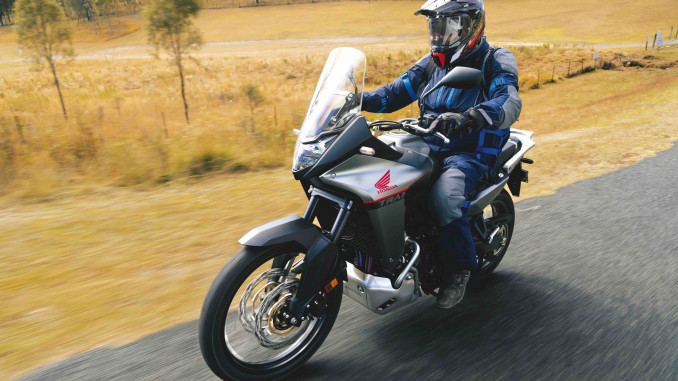
We were impressed when Honda launched the XL750 Transalp in 2023. Here’s what ARR thought of the adventure twin after riding it at the bike’s launch…
I was thinking about this new adventure twin when the back tyre started sliding, breaking traction as I fed the power of the new Transalp’s engine through the gearbox and into the Metzeler Karoo Street rear tyre, until a quick flick of my boot fired the bike up a gear through the quickshifter. The higher ratio combined with a steady throttle allowed the tyre to grip and push the bike forward, the slide fading and the wheel coming back into line with the front.
It’s a buzz to ride like this, feeling the back end break traction and move around, and it’s pretty easy and fun to do so on the loose gravel of the Gold Coast hinterland where launch ride leader Daryl Beattie had brought us for our day on the Transalp.
To get the bike to break traction and to fire it through the gears, you’ll need to put it in the User riding mode and turn off traction control, and the quickshifter is an optional extra, so there a few little hoops to jump through. But that, in some ways, is modern motorcycling.
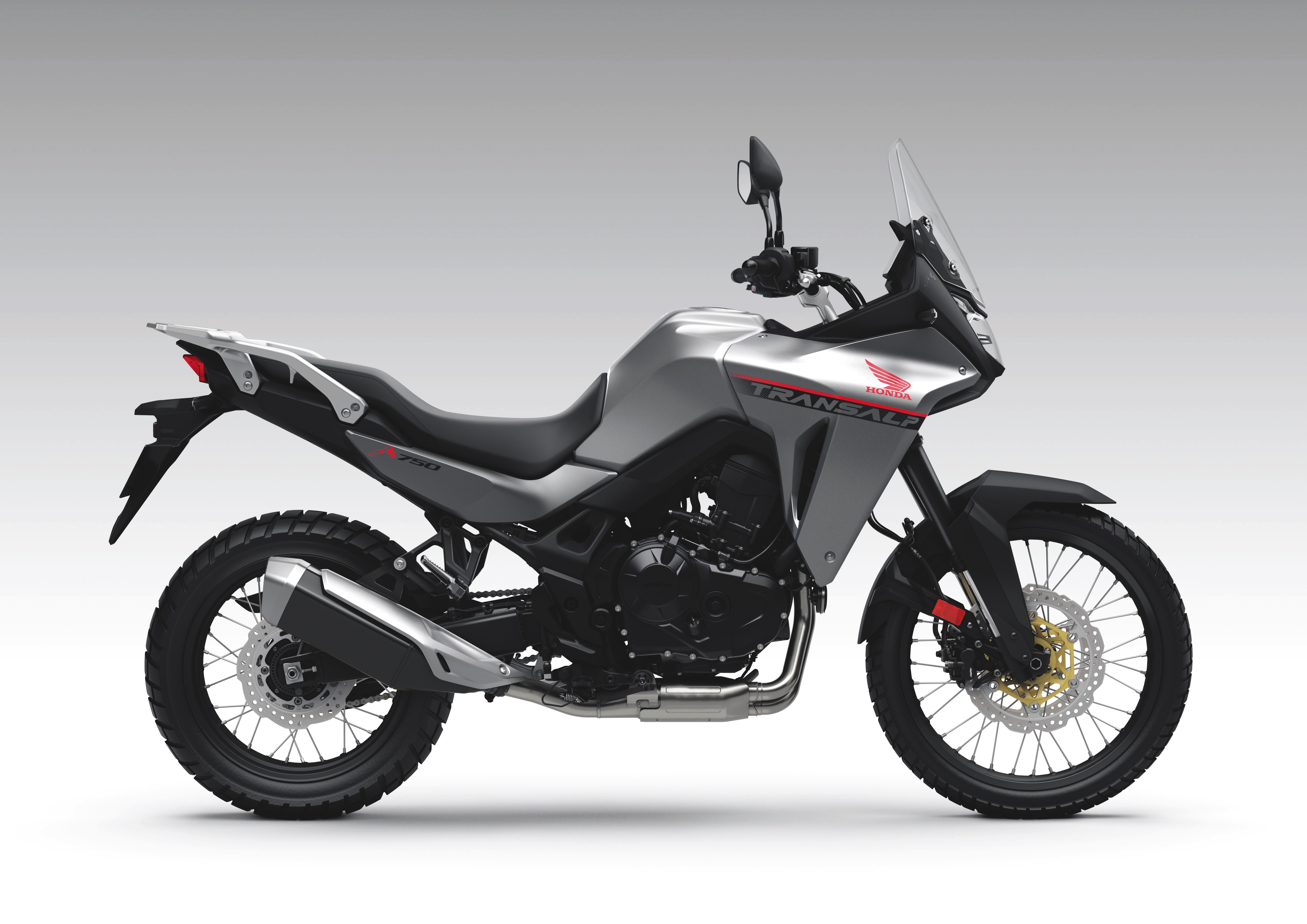
WHO IS IT FOR?
For a huge crop of young riders who got their licences during the COVID-19 lockdowns, for more mature riders feeling the pinch of higher interest rates, for anyone not liking the prices of the more exotic adventure bikes out there… Honda’s Transalp is now available.
At $14,499 plus on-road costs — around 16k ride away depending on where you live — it’s amazing value for a new model made in Japan. You get to choose between three colour schemes and there’s a huge range of accessories available so you can make it your own… although it can be argued some of the accessories only bring the bike up to the spec of some of the more expensive competitors, so if you need those things, maybe the bike isn’t that cheap after all.
Honda has used its design and manufacturing skills to produce a bike that should appeal to a broad swathe of riders — there’s a steel chassis and lightweight twin-cylinder engine, modern electronics, 21/18in wheels, a 5in TFT colour instrument panel with Bluetooth connectivity, full LED lighting and even auto indicator cancellation.
Of course the low price means there are features missing and other aspects of the bike aren’t to the level of the more expensive machines, and it’s up to each buyer to decide if those things are important to them — cruise control, cornering ABS, tubeless rims, Apple CarPlay and electronic suspension among them.

ON THE ROAD & DIRT
Throw a leg over and you’ll find a neutral riding position, an 850mm seat height which is only tall if you don’t ride adventure bikes. The handlebars and footpegs are exactly where you’d expect, so the ergonomics are good.
Fire it up and there’s a very quiet, pleasant throb from the 270-degree crank-equipped motor, which feels the same as the unit in the CB750 Hornet — because it is. There’s throttle by wire, five riding modes (one more than the Hornet, Gravel), 92hp (67.5kW) and 75Nm of torque and an assist/slipper clutch.
It’s a compact motor utilising a Unicam head, omits a balancer gear by running the balancer shaft directly from the primary drive gear, and the whole package gets by without the need of a water-cooled oil-cooler.
Like the Hornet, there’s a new Ni-SiC (Nickel-Silicon Carbide) cylinder coating to increase engine efficiency.
I can’t say how much any of the modern features have individually contributed to fuel economy, but with a claimed 23km/L and a 16.9-litre fuel tank, that’s a touch under 400km from a tankful… plenty for long-distance touring.
Pick it up off the sidestand (the centrestand is an option) and it feels quite light — because at 190kg, it is.
I headed out in the Gold Coast traffic in Standard mode, where the electronics offer middle-of-the-road everything, from throttle response to engine braking to traction control. It’s an easy bike to ride around town, the riding position and seat height giving a great view of what’s around you, the engine easy to use, the transmission slick. It’s easy to get through traffic and U-turns are an absolute doddle…
We spent just enough time in Gold Coast traffic for me to know the Transalp would be a great commuter. The high seat gives you a great view, the 21-inch front wheel makes it easy to point through the gaps, the dirt-bike steering lock makes it easy to go around things, and jumping kerbs, of course, would be child’s play. There’s even a standard rack to strap on your lunchbox.
Away from the high-rise, we rode up through Mount Tamborine, so I switched to Sports mode, which made the engine that bit more responsive. Add in a few more revs and I was wanting to charge through the corners harder and harder. Of course the limits of traction offered by dual-purpose tyres — especially the skinny 21-incher up front — were found pretty easily as so many of the things that make the commuting and dirt riding practical work against the bike when you’re pushing hard on bitumen. I would have been happier on a Hornet, but it wasn’t like I was having a terrible time on the Transalp.
Then we transitioned to the gravel, where the wheel sizes, tyres and riding position were perfect, where I could stand up and use my knees to absorb the bumps, where an adventure bike is most at home. I shifted to Gravel mode.
The dirt for the launch was pretty tame, primarily smooth gravel roads. I could have ridden a sportsbike along the route and not damaged anything, but the Transalp… it was an absolute hoot in those conditions. Until the traction control kicked in, which it did way too early. Despite being in Gravel mode, the traction control didn’t really want to let the rear wheel spin much at all, so I had to stop, put the bike in User mode, turn off traction control and get going again. Now I was having fun.
The power of the Transalp is produced higher in the rev range than I’d really like in an adventure bike, the tacho really needing 4000 showing before she starts to boogie. From there it’s pretty linear to redline, but that’s road bike territory… and guess what, the engine was also built for the Hornet… and the European market will often favour a bike better suited to road use.
You can switch between riding modes on the fly, but to turn off traction control you have to go into the menus. It’ll remember the setting until you turn off the ignition, but do that and you’re back to having traction control on again, even in User mode. The upshot is I’d only use Gravel mode if going from bitumen to dirt, stopping to switch off traction control if need be.
One big advantage of Gravel mode is it switches off ABS to the rear… and you can’t switch off the front ABS at all.
I haven’t mentioned Rain mode so far because, well, I didn’t use it. It’s got the softest power delivery and all the safety settings are turned up to maximum.
I really think most experienced riders will set up their preferences in User mode and skip the standard modes. I liked full power, minimum engine braking, “road” ABS and moderate traction control. This worked for me on the bitumen and I’d just stop and turn off traction altogether on the dirt. This combination also gives the added bonus of being able to pull awesome wheelies…
THE PARTS
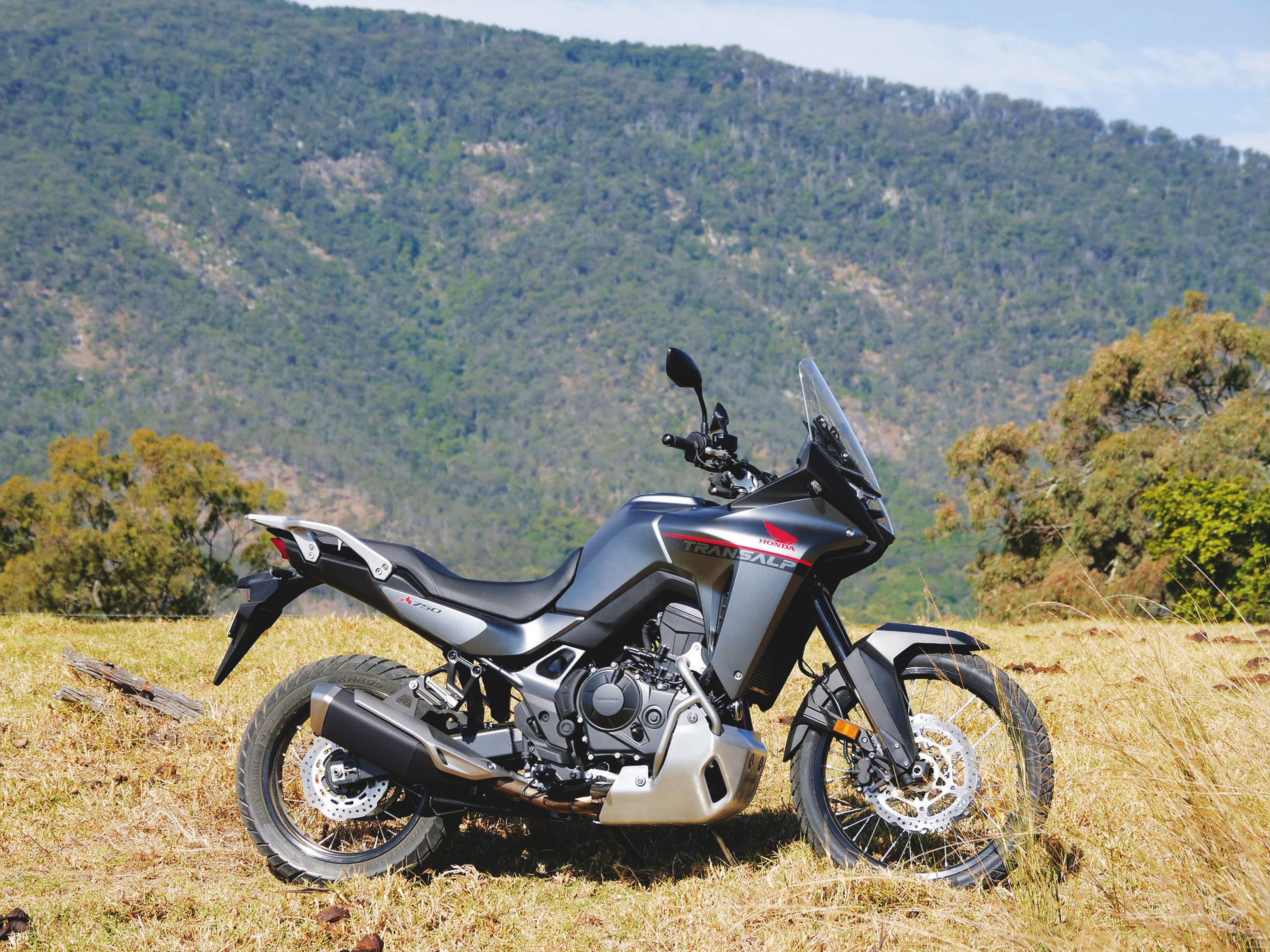
Honda developed the lightweight steel chassis for both the Hornet and Transalp; the mainframes are the same, but the subframes differ. At 18.3kg it’s hard to argue for alloy, which would be more expensive to build and repair.
The front suspension is non-adjustable 43mm Showa SFF-CA (Separate Function Fork-Cartridge) USD forks with 200mm of wheel travel. The rear is Pro-Link set-up with a Showa single shock adjustable for preload only. The wheel travel is 190mm and the swingarm is aluminium.
It’s almost like they built the suspension to be upgraded. I asked the crew if the rear shock could be firmed up and Daryl Beattie was then playing mechanic, setting the preload to its maximum for me.
“These come from the factory for a 70kg or so rider,” the former GP star turned adventure rider told me. I’m closer to 100, especially in adventure boots and gear. “We’re (his tour company) experimenting with different springs soon. You’d definitely need a firmer spring for the Transalp,” he told your tall, overweight editor…
For many riders stepping up to the Transalp from a smaller bike, the suspension will be fine, but if you’re coming from a dirt bike background or are an experienced adventure rider, you’ll probably want to do something about getting better performance from both ends of the machine, but especially the rear. Increasing the rear-suspension preload improved the comfort and feel I had for the bike, but didn’t cure it.
The wheels are tube type, which led to an interesting conversation with Beattie. “I see guys with tubeless rims end up dinging them too often, and then you need to put in a tube in anyway,” he told me. “You’re less likely to bend a rim with tubes in.”
Brakes are 310mm wave discs gripped by twin-piston calipers — they require a decent squeeze but are fine overall. The rear 256mm disc suits the bike fine.

THE ELECTRONICS
The Transalp features a 5in TFT instrument panel with Bluetooth connectivity, there’s a USB socket under the seat, LED lighting all around, daytime running lights, self-cancelling indicators, emergency stop signals and a simplified electrical system (Controller Area Network and Body Control Unit).
The instruments offer four types of speed/rpm display — three analogue rev counter styles and one bar — according to rider preference — as well as fuel gauge and consumption, riding mode selection and engine parameters, gear selected and customisable shift-up point on the rev counter. Missing was ambient air temperature. Management is via the screen and switchgear on the left switchblock.
Also incorporated into the interface is the Honda Smartphone Voice Control system, which links the rider to their smartphone while on the move and allows voice management of phone calls, messages, music and navigation. A helmet-mounted headset is needed, and the smartphone connects to the dash via Bluetooth. Management of Honda Smartphone Voice Control is also possible using buttons via the left switchgear.
I didn’t try out the connectivity during the launch — I’d wasted time on the hornet launch trying to get my iPhone to pair up with the bike unsuccessfully and didn’t want to repeat the experience, so decided to leave this for when we have a Transalp for a longer period.
Modern tech has arrived at the indicators: not only are they also daytime running lights, they self-cancel when the bike detects a difference in the speed of the wheels by changing lanes or making a turn. As far as I could tell the system worked perfectly, and I didn’t notice anyone on the group ever leaving their indicators on after a turn.
They also flash to warn of an emergency stop. Decelerate hard from at least 56km/h (Honda describes it as “negative acceleration of a minimum of 6.0m/s2”) and the hazard lights flash in addition to the brake lights coming on. If ABS is activated, they will flash at a lower rate of “negative acceleration”.

THE ACCESSORIES
The list of genuine Honda accessories is as long as your arm, or at least it seems so. Initially I thought many of the accessories should be standard equipment, but when I started to realise how the company was aiming the bike at such a diverse range of riders, my attitude softened a bit; someone commuting to work may not need a bash plate.
But everyone else on a Transalp does. The underbelly looks dangerously exposed to rocks, with an extension of the sump sticking straight down… it’s protected a little by the exhaust system, but landing it on a log looks like it could do serious damage, so the first thing to add to the bike if I had one would be a bash plate.
Beyond that, there are all sorts of accessories to protect the bike, to make the ride more comfortable and to take a load. The bike should be an excellent and economic adventure tourer, so we’ve requested a test bike equipped with the Pannier Pack: heated grips and panniers, complete with inner bags. We’d also add the Comfort Pack for touring: small (3L) tank bag, tall screen and wind deflectors, power socket and “Comfortable Passenger Footpegs”.
The Top Box Pack adds a 50L top box, inner bag and all the mounting gear required, plus the centrestand.
The Rally Pack and Adventure Pack offer different levels of crash protection — engine and side guards, bash plate, fog lights, quickshifter, wider footpegs and more. Beyond the items in the packs there are additional accessories available.
All of the accessories are available separately and none has to be specified at the time of purchase — you can come back anytime and buy whatever you want.
The test bikes available on the launch were mostly equipped with some level of accessories, so be aware that what the photos show mightn’t match perfectly what you find in your dealership.
I got to try out the tankbag, tall screen and deflectors and liked them. The tankbag is quite small but convenient and doesn’t get in the way. The screen is protective and well designed and there was little buffeting.

WHO’S IT FOR?
The mid-range adventure bike market has boomed over the past decade or so as the top-end machines got bigger, heavier, more complex and expensive. The market was ripe for bikes which fit between the popular big-bore singles and open-class adventure bikes, and they sold in big numbers when they arrived.
Honda’s a little late to the party but has come in with a very keenly priced machine at the “softer” end of the market. The Transalp isn’t a dirt bike you can ride all day, it’s more like a bike built to take on different challenges. As such it has its own set of compromises, but every adventure bike does.
If you’re looking for really strong ability in the dust, you’re probably better off with an Africa Twin — Honda’s range of 1100cc twins are true desert-crossing and highly capable adventure bikes. But they can cost twice as much as a Transalp, are heavier and while more rewarding to the advanced rider, are intimidating to the less experienced and confident.
So hard-core adventure riders won’t be interested in the Transalp, and that’s fine — for everyone else, from the less experienced coming off their LAMS licences to the more casual rider looking for a dirt road tourer to someone looking for their first adventure bike, the Transalp offers a lot for not a lot
of money.
And the ability to then easily add lots of accessories to personalise it the way you want it? That should make this bike a winner for Honda and everyone who buys one.

SPECIFICATIONS
Honda XL750 Transalp
ENGINE
Type: Liquid-cooled OHC 4-stroke 8-valve parallel twin with 270° crank and Unicam
Capacity: 755cc
Compression ratio: 11.0:1
Engine management: PGM-FI electronic injection
PERFORMANCE
Claimed maximum power: 91.8hp (67.5kW) @ 9500rpm
Claimed maximum torque: 75Nm @ 7250rpm
Fuel consumption: 4.35L/100km (23km/L) claimed
TRANSMISSION
Type: 6 speed manual
Final drive: Chain
Clutch: Wet multiple, assist slipper clutch
CHASSIS AND RUNNING GEAR
Chassis: Steel diamond
Front suspension: Showa 43mm SFF-CA — 200mm travel, non-adjustable
Rear suspension: Monoshock damper, Pro-Link swingarm, 190mm travel, preload adjustable
Front brakes: Dual 310mm x 4.5mm ‘wave’ discs with axial-mounted 2 piston calipers, ABS
Rear brake: Single 256mm x 6.0mm ‘wave’ disc, single-piston caliper, ABS
Tyres: F: 90/90-R21, R: 150/70-R18
DIMENSIONS AND CAPACITIES
Rake: 27°
Trail: 111mm
Claimed wet weight: 208kg
Seat height: 850mm
Wheelbase: 1560mm
Fuel capacity: 16.9L
ELECTRONICS, RIDER AIDS & CONVENIENCE FEATURES
2-channel ABS, 5-inch TFT instruments, Honda Smartphone Voice Control, USB-C socket under seat, auto cancel indicators, LED lighting, Daytime Running Lights, Emergency braking warning
ETCETERA
Price: $14,499 + dealer delivery & statutory charges (approx $16,000 Ride Away NSW)
Colours: Mat Iridium Gray, Metallic Mat Ballistic Black, Metallic Ross White Tricolour
Test bike supplied by: Honda Australia
Warranty: Two years unlimited kilometres
Website: https://motorcycles.honda.com.au/models/onroad/adventuretouring/xl750-transalp#