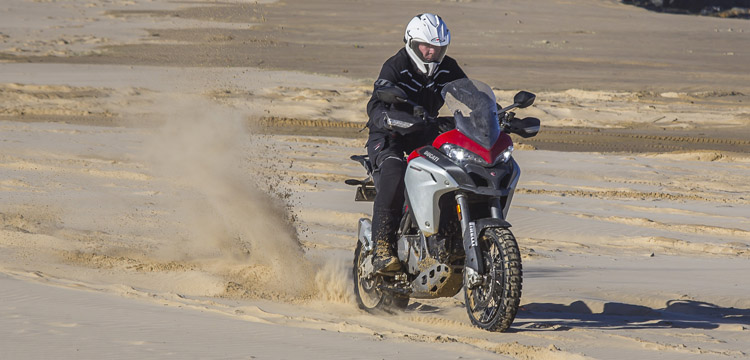
The Ducati Hypermotard 689 Mono RVE was one of the most fun bikes we tested in 2025.
There’s something about a supermotard-style bike like the Ducati Hypermotard 689 Mono RVE that makes you feel like you’re breaking the law just riding it. Maybe it’s all those movies in which guys rob banks or chase spies while thrashing mad motos through cobbled European piazzas. Whatever the case, there’s no denying that lightweight, dirtbike-style machines fitted with road tyres are great fun for “spirited” riding. Maybe not so much for long-distance touring, but trackdays can also be fantastic on these no-frills fangers.
The Hypermotard 689 Mono RVE is Ducati’s predictably “extra” take on the supermotard class. The original Hypermotard debuted as a concept at the 2005 EICMA trade show in Milan and won Best of Show, before being released as the Hypermotard 1100 in 2007. Since then, it has evolved through several iterations, including the 796, 821, 939 and 950 models. Despite the latest 698 model being the smallest-capacity Hypermotard, it is arguably the most radical of them all, primarily because of its ground-breaking powerplant. I’m not sure there’s a bike out there that is more defined by its engine than the 698 Mono. This is because it boasts the most powerful single-cylinder production engine in the world, a Frankenstein’s Mono-ster of a thing boiled down from the bad-ass bones of a 1299 Panigale V-Twin.

FAST SINGLE
Ducati has chosen marketing over meaning by putting the 659cc short-stroke single-cylinder engine in a bike called the Hypermotard 698, just as a 1285cc Superquadro twin-cylinder engine powers the 1299 Panigale. The two engines also share the same piston and combustion chamber designs. The massive racing-type piston, which boasts a diameter of 116mm, has been paired with an ultra-short stroke of 62.4mm. The resultant extreme bore and stroke ratio of 1.86 allows very high rotation speeds to be achieved. In fact, the Superquadro Mono engine is capable of reaching 10,250rpm, which is just staggering for a single-cylinder donk. In the process, it produces claimed maximum power of 57kW at 9750rpm and torque of 63Nm at 8000rpm.
The 659cc unit also inherits large (46.8mm diameter) titanium intake valves and 38.2mm steel exhaust valves from the twin-cylinder superbike engine. The combination of huge valve diameters and high revs introduces significant inertial stresses, which is where Ducati’s famous Desmodromic system comes into its own. It allows the limits imposed by the valve springs to be overcome, enabling extreme valve lift laws with large-diameter valves at high engine speeds.
So, what do you do with such an engine? Well, you design a bike around it; give it a tall seat and high front mudguard, lightweight trellis frame, fully adjustable suspension front and rear, and a comprehensive electronics package. Think Panigale V4-style electronics such cornering ABS, power launch, and traction, wheelie and engine brake control. Then wrap sticky Pirelli Diablo Rosso IV tyres around its lightweight alloy wheels. Now you have a slim, slick, sophisticated bike that weighs only a touch over 150kg, powered by a free-revving 57kW single. Just to provide some perspective, the latest Royal Enfield Himalayan — not a direct competitor, of course, and you could almost buy three new Himalayans for the price of one RVE, but bear with me — is a single-cylinder engine with a peak output of 29kW powering an almost 200kg bike. I know which one I’d rather go off-road on, but when it comes to pure performance and pizazz, the 698 Mono is in a league of its own.

MOTARD STYLE
It’s also very unique in the looks department. In a good way. Our Hypermotard 698 Mono RVE test bike is spectacular in its Graffiti livery (with black frame and red subframe), which Ducati says is inspired by works of street art. It certainly turns heads wherever we go, noticeably younger ones. You can also choose the base model in classic Ducati Red (with powder-coated red frame and black subframe), but you don’t get a quickshifter (although you can add it as an accessory). These are the only differences between the two models, resulting in a price differential of $1300.
The RVE does look purposeful but also plain fun, beckoning you to jump aboard. When I do, the first thing I notice is how high the seat is. At 904mm above the bitumen, it feels great to me, but I’ve got long limbs. It means plenty of legroom and a nice high vantage point for good visibility in traffic. The Ducati Performance low seat accessory takes the height down to 889mm or, when combined with the low suspension kit, to 849mm. As with any long, thin bench seat, it is better suited to younger bums, although I spend a full day in this flat saddle and stay comfortable because it’s easy to shift around on the seat. (Speaking of youth, Ducati says the target market is riders in their mid-20s, but as you need mid-20s cash to buy the bike, I suspect the real age might be a bit higher.)
There’s simple, self-explanatory switchgear on either end of the aluminium handlebar, which features U-bolts designed to be mounted in two positions, varying the advancement of the ’bar by 8mm. And in the middle of it all is a small 3.8in LCD display employing something called Improved Black Nematic technology. Apparently that means white digits on a black background, which to be fair does help with visibility. It’s all pretty easy to read, with speed, bar tacho, gear selection and riding mode all displayed on the home screen.

RIDING IT
I thumb the starter button to generate a happy thumping from the Superquadro Mono. While it all sounds a bit tame with the stock exhaust at idle and low revs, once you really get into it, the engine comes alive and the double silencers (mounted on the sides of the tail) hiss and spit like angry cobras. But more on the fun stuff shortly. Heading off into traffic, the bike is so easy to ride straight off the bat. It takes no time at all to get used to the engine and accompanying gearing. First gear is definitely long (Ducati says it is designed that way to provide maximum thrust from low-speed curves), so you can cruise around in that, or make use of the fact that 70 per cent of the bike’s torque is available at 3000rpm, so you can bobble about in second.
If you hang around the engine’s sweet spot at around 4500-5000rpm, you are rewarded with smooth and unhurried performance, with buckets of power just ready to tap into. I find third gear to be perfectly placed in this Goldilocks zone at 60km/h and fourth gear at 80km/h, while fifth and sixth both feel happy in the 100-120km/h range. Of course, this is all a bit boring and practical, but it is nice to be on a bike that goes from trafficus domesticus to trackus terrifyingus with a twist of the wrist. Dare I even say it’s a great commuter — tall, slim, light and simple — but of course it is a whole lot more than that.

Okay, so time to thrash it. And doesn’t the Hypermotard just love getting hyperactive! Torque pumps out of the big-bore single, with at least 80 per cent of the engine’s torque available from 4500rpm all the way up to redline. It just steams ahead relentlessly, and then when you let off the power, strong engine braking kicks in — there’s no coasting allowed in Mono-land. Of course, the power, torque and other characteristics change depending on the riding and power modes chosen, but the unique feel of the single-piston thumper always remains.
There are four riding modes available (Sport, Road, Urban and Wet) to which the engine mode, traction control, engine braking and ABS levels are assigned by default. Sport mode is for the track, so it’s full power and instant throttle response. Road mode is also full power, but with smoother throttle response and increased electronics intervention. Urban mode cuts the power down to 43kW and ups the electronic controls a bit more, while Wet mode has the same lower power but the electronic safety net is at full stretch. I choose to ride in Road mode for most of the test period, which I think most riders would end up doing unless they were riding on the track or in the rain. Road mode employs the middle of three levels of engine braking, which feels just about right to me.

BALANCING ACT
The Hypermotard 698 is also an exceptionally well-balanced motorcycle. A close-to-ideal weight distribution of 48.5 per cent on the front axle and 51.5 per cent on the rear axle means the front end feels more communicative and less prone to understeering than many comparable machines. And the way the bike’s weight is kept down is also worth noting. For example, the trellis frame uses differentiated sections and thicknesses to come in at only 7.2kg. The lithium-ion battery, cast-alloy wheels and brake discs with aluminium flanges all contribute to keeping things light, as does the Marzocchi fork, weighing in at only 8.1kg. A lightweight double-sided swingarm made of a single piece of cast aluminium combines lightness (3.9kg) and stiffness, and works via a progressive linkage with Sachs monoshock.
You can mess around all you want with the front suspension. Preload adjustment occurs on both fork legs, while hydraulic damping has separate functions, with rebound on the right tube and compression on the left. Calibration is via remote adjusters on the fork head. The rear shock’s damping settings can also be modified thanks to remote adjusters. But, to be honest, the standard settings feel pretty spot on for most riding. It’s all just so flickable and fun, firm but not uncomfortably so, and definitely able to soak up bumps and blast over poor surfaces without drama. The Pirelli Diablo Rosso IV tyres are a great choice for this bike as they really do perform so well on road and track, leaving no ambiguity as to the objectives of the bike. The steering is super quick and the whole package is just a joy to throw about.

The brakes are predictably superb, with a single 330mm disc (the same diameter used on the Panigale V4) and radial caliper up front, all developed by Brembo for the Hypermotard 698 Mono. At the rear there is a single 240mm disc worked by a floating caliper. There’s more than enough stopping power for any situation, plus four levels of ABS to choose from. Two of these integrate what Ducati calls its Slide-by-Brake functionality, which, through the use of the rear brake, allows for even relatively inexperienced riders to get into power-sliding shenanigans on the track.
Even if you’re not planning on robbing any banks or sliding into turn two anytime soon, the Hypermotard 698 Mono RVE could still be a great choice of ride. It’s light, relatively powerful and plenty of fun. It’ll also get you from A to B with minimal fuss. I have to admit, I wasn’t sure whether the Mono would be my cup of tea when I first jumped on, but I can honestly say I definitely did not want to give the test bike back. It feels like a machine that warrants a spot even in the most stacked garage, with its unique looks, attributes and presence. I suggest you get out there and test ride one through the nearest thing to a cobbled piazza that you can find.

PARLEZ-VOUS MOTARD?
Strangely enough, to understand the essence of this Italian thoroughbred, one must first take a short lesson in French. The word motard is slang for motorcyclist (or sometimes motorcycle cop). Its pairing with the prefix super to make supermotard comes from the supermoto sporting tradition of fitting off-road machines with tyres and parts that allow them to race on both dirt and tarmac. The sport became so popular, especially in France, that production models made by major manufacturers soon joined homemade bikes on the scene.
Then there’s the word banlieue, which basically means “outer suburb” in English, but in the context of modern Europe is a socially and economically challenged area of a large city. The relevance here is that every rebellious kid growing up in such a place wants a badass supermotard to thrash around the streets. They want to rage against the machine on an outrageous machine. Hell, who doesn’t?
So, what’s a Hypermotard then? Well, it’s basically Ducati’s own name for a hooligan’s dream bike made with the engineering and design standards of a Panigale… with a price to match. The first Hypermotard was created by a guy called Pierre Terblanche, who you’d probably wager is French, but he’s actually South African. He’s well known to Ducatista as the father of the MH900e, 999 and first Multistrada in the early 2000s, before he went on to design the first Hypermotard in 2005. Perhaps less known is the fact that he was central to the creation of the first Royal Enfield Himalayan in 2018, also a single-cylinder machine, although with a considerably different design brief and markedly less grunt.

MONO BY NAME, MONO BY NATURE
The Ducati Wheelie Control (DWC) system increases rider safety by analysing the bike’s setup, detecting wheelies and managing engine output accordingly. DWC is integrated into the riding modes and is adjustable to four levels.
Levels four to two deal with optimising thrust during acceleration at higher performance levels, or preventing the front wheel from leaving the ground at the most conservative ones.
But, uniquely on the Hypermotard 698 Mono, level one has been calibrated for motard riding, so that when you crack the throttle, the front wheel will lift as high as possible without “assuming a dangerous and uncontrollable position”.

SECOND OPINION
I only had a few short squirts on the Hypermotard 698 Mono but that was enough to leave me wanting more… much more. Despite the tall seat height and my short legs, I had no dramas lifting this lightweight beasty off its sidestand, and within a couple of hundred feet down the road I felt right at home on it.
The engine is a rip-snorter of a thing. Sure, it can be mild mannered at low revs, but crack the throttle and it wants to loft the front wheel at every opportunity. The brakes are likewise potent and urge you to apply them later and harder every time until the rear wheel wants to lift off the deck. Yep, this thing is the ultimate hoon bike.
But it’s much more than that; it’s fantastic on an open winding road, it is a master of the tighter twisty stuff, it is ridiculously easy to ride when weaving through traffic and, to my eye, it looks bloody fantastic. I reckon it would be a hoot on a racetrack, too, although it would no doubt be best suited to tighter tracks than fast-flowing circuits.
It ain’t cheap at $25,400 ride away, but for a single it’s a helluva lot of bike! – Dean Mellor

SPECIFICATIONS
Ducati Hypermotard 698 Mono RVE
ENGINE
Type: Superquadro mono, single-cylinder, four valves per cylinder, Desmodromic timing, two-balance countershafts, liquid cooled
Capacity: 659cc
Compression ratio: 13.1:1
Engine management: EFI, 62mm throttle bodies with full ride by wire system
PERFORMANCE
Claimed maximum power: 57kW @ 9750rpm
Claimed maximum torque: 63Nm @ 8000rpm
Fuel consumption: 4.8L/100km (as claimed and as tested!)
TRANSMISSION
Type: Six-speed with dual-direction quickshifter
Final drive: Chain
Clutch: Slipper and self-servo wet multiplate clutch, hydraulic control
CHASSIS AND RUNNING GEAR
Chassis: Tubular steel trellis frame
Front suspension: 45mm Marzocchi fully adjustable USD fork, 215mm travel
Rear suspension: Progressive linkage with Sachs fully adjustable monoshock, 240mm travel
Front brakes: 330mm aluminium flange disc, Brembo M4.32 caliper with Bosch Cornering ABS
Rear brakes: 245mm disc, single piston floating caliper, with Bosch cornering ABS
Front tyre: 120/70 ZR17 Pirelli Diablo Rosso IV
Rear tyre: 160/60 ZR17 Pirelli Diablo Rosso IV
DIMENSIONS AND CAPACITIES
Rake: 26.1°
Trail: 108mm
Claimed weight (wet): 151kg
Seat height: 904mm
Wheelbase: 1443mm
Fuel capacity: 12L
ELECTRONICS, RIDER AIDS & CONVENIENCE FEATURES
Riding Modes, Bosch cornering ABS, Ducati Traction Control (DTC), Ducati Wheelie Control (DWC), Engine Brake Control (EBC), Power Modes, Ducati Power Launch (DLC), Ducati Quick Shift (DQS) Up/Down
ETCETERA
Price: $25,400 ride away
URL: https://www.ducati.com/au/en/bikes/hypermotard/hypermotard-698-mono
Warranty: Two-year, unlimited kilometres