The Honda CB1000 Hornet SP is a Fireblade-derived naked loaded with premium kit at a modest price. We take it on a 1000km+ road ride and spend a day on it at SMSP to see how it stacks up.
For me, there’s somewhat of a personal connection with the Honda CB1000 Hornet SP. The Hornet name isn’t just a badge — it’s part of my own riding history. Back in the mid-2000s I owned a CB900F Hornet, and it left a lasting impression as a bike that blended sportsbike grunt with everyday usability. But the Hornet story goes back even further for Aussie riders, to the late ’90s, when the CB600F first hit local showrooms. With its CBR-sourced inline four, sharp styling and affordable price, it quickly won a following among those chasing sportsbike thrills without the pain or cost. A few years later, the bigger CB900F arrived, offering more muscle in the same lean, streetfighter-styled package. Both cemented the Hornet as a fun, fast and great-value option for everyday riders.
After a long hiatus, Honda revived the Hornet name here in 2023 with the CB750 Hornet — a midsize naked with a ripper of a parallel twin that blended a taut streetfighter silhouette with all-round usability. In December 2024, when the 2025 range hit local dealerships, Honda added the CB500 Hornet — essentially a rebadged and restyled CB500F — giving LAMS riders a fresh way to tap into the Hornet identity.
Now Honda has gone all-in at the top end of the family. Australian riders don’t get the choice between a standard and an SP — we only get the CB1000 Hornet SP, the fully loaded version designed to showcase everything the Hornet badge can be. And that’s no bad thing, because the SP comes dripping with high-end componentry.
ENGINE & PERFORMANCE
At the heart of the Honda CB1000 Hornet SP is a Fireblade-derived 999cc inline-four, plucked from the 2017 CBR1000RR and tuned for nakedbike duty. Honda quotes 115.6kW (155hp) at 11,000rpm and 107Nm at 9000rpm. Gases exit through a not-so-pretty exhaust system, but it features a Revolutionary Controlled (RC) exhaust valve that opens at 5700rpm. The result is a powerplant that’s deceptively docile at low revs, muscular in the midrange and ferocious when you let it scream.
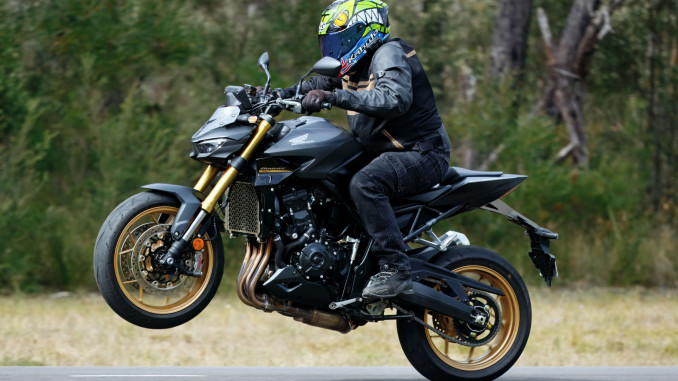
The rider-selectable modes play a big role in the engine’s flexibility. Swapping between Rain, Standard, Sport and two Custom maps is as simple as tapping the ‘Mode’ button on the left switchblock and momentarily closing the throttle, so it’s easy to tailor the bike to conditions on the fly. Rain softens throttle response and ups traction control response for wet commutes, Standard slightly dampens throttle response and balances power and engine braking for everyday use, and Sport sharpens everything up for backroad or track work. If you want to go full hooligan, either of the Custom modes lets you dial settings to taste — including the option to switch traction control off completely if wheelies are your thing.
Around town, the Hornet will trundle smoothly in higher gears, but on the Alpine Way’s endless switchbacks, where I really started to gel with the SP, the torque-rich midrange made short work of the steep climbs and hairpins. Get the tacho past 7000rpm and the Hornet transforms, surging to the 11,500rpm redline with a spine-tingling howl. On track the effect is even more pronounced: once the RC valve swings open, the Hornet SP howls like a race bike, nudging an indicated 240km/h down Sydney Motorsport Park’s straight before diving into Turn 1.
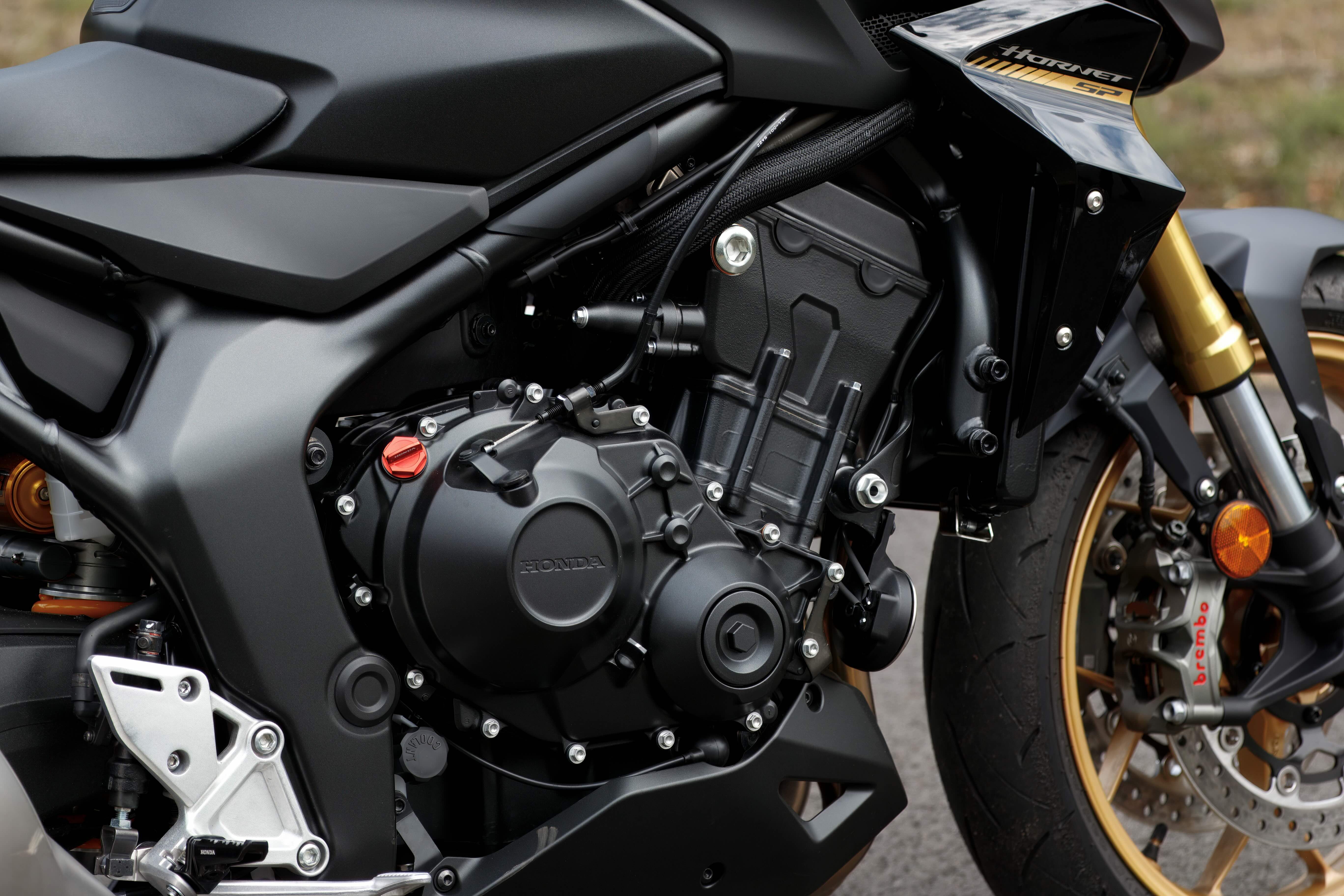
Compared to the Fireblade, Honda shortened the Hornet’s second through fifth gears for stronger acceleration, while sixth remains tall enough for relaxed freeway cruising. The balance was spot-on at SMSP, with third gear covering much of the track, while second gave punch out of the hairpin and sixth was only required momentarily on the straight.
The standard-fit, adjustable quickshifter is a ripper. Upshifts are lightning-fast at full throttle, and smooth downshifts keep the chassis calm under hard braking. At partial throttle openings, the system can be slightly notchy, but overall it transforms the way the bike is ridden. An assist/slipper clutch keeps the rear wheel composed under aggressive downshifts, which was handy both on slippery alpine roads and at SMSP.
On-road fuel efficiency was impressive on test. Honda claims 5.9L/100km, but over 1063km of road riding, the test bike used just 43.99L, averaging 4.14L/100km. With a 17L tank, that means a realistic 250-300km between fills, impressive for a naked litre bike with superbike levels of performance.
CHASSIS, HANDLING & BRAKES
The CB1000 Hornet SP features a new steel twin-spar frame, said to be 70 per cent stiffer in torsion than the old CB1000R’s, with a narrow pivot point for a slim-waisted feel. Combined with a forward-biased 50.9/49.1 weight distribution, it gives the SP a feeling of agility combined with stability.
From the moment you lift it off the sidestand, the bike feels lighter than its 212kg kerb weight suggests. In the garage it’s easy to push around, and on the road it changes direction like a middleweight. Honda’s decision to run a 180/55ZR17 rear tyre rather than a wider 190 or 200 was inspired, keeping turn-in quick without sacrificing much in the way of grip. Over the mountains separating Victoria and New South Wales, the Hornet SP flicked from side to side effortlessly, yet once committed to a corner, it held a line with precision.
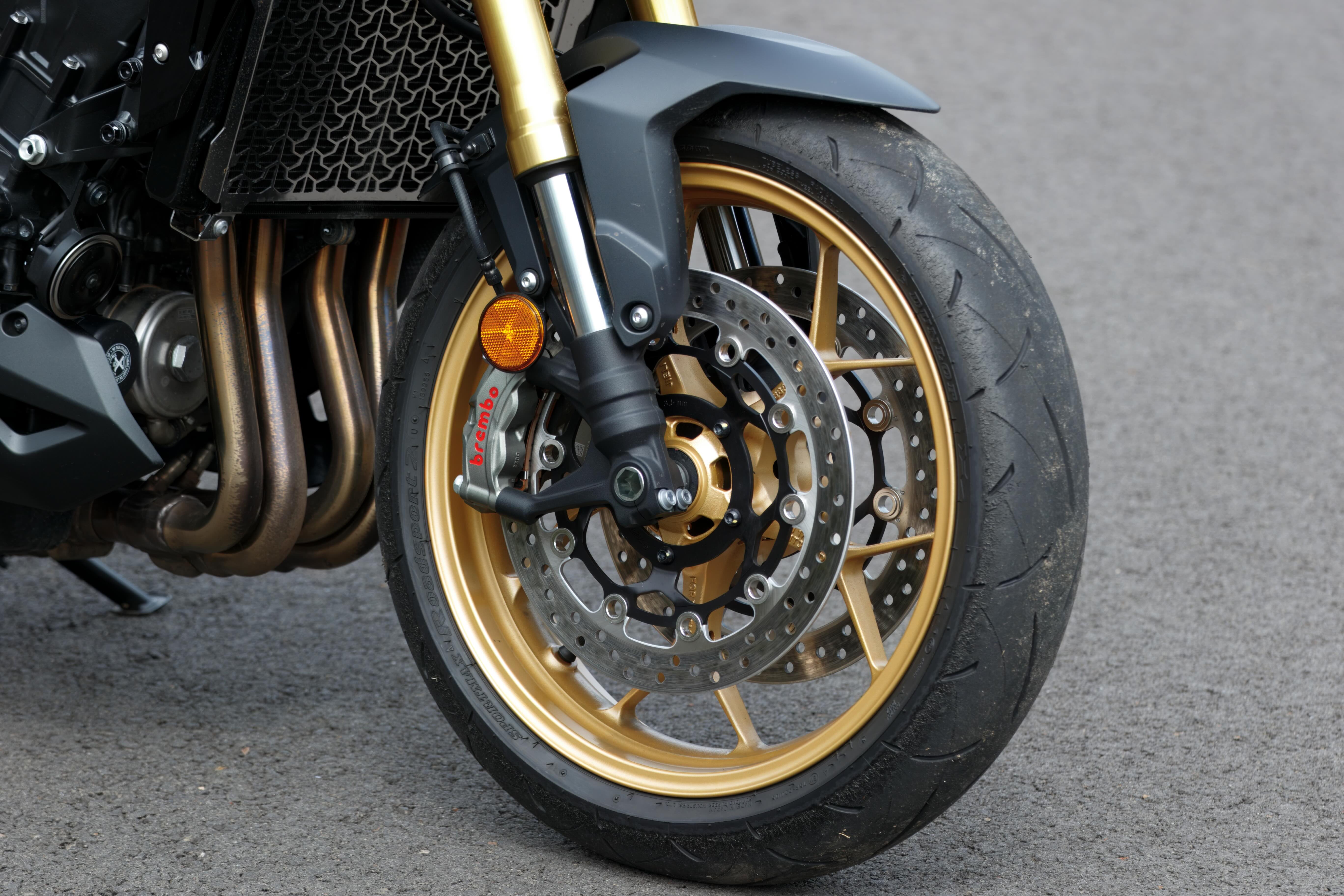
The suspension completes the package. Up front, a fully adjustable 41mm Showa SFF-BP fork offers excellent support under braking and composure over bumps. At the rear, the Öhlins TTX36 shock with automatic preload adjustment gives the bike premium-level damping. Most of the time it’s beautifully judged — plush on the freeway, taut in the twisties — but loaded with an 80kg rider wearing several layers and protective gear (mostly from the cold), and carrying 10kg of luggage, big hits could feel a bit harsh, suggesting a click or two of damping adjustment might help, but overall the balance between comfort and control is outstanding.
Braking is handled by Brembo Stylema radial calipers clamping 310mm floating discs. Power is immense, feel at the lever excellent, and ABS calibration spot-on. On Alpine roads the system dealt smoothly with emergency stops when wildlife leapt out; on track the Brembos delivered fade-free performance lap after lap. A Nissin caliper and 240mm disc cover the rear, offering useful mid-corner corrections.
At Sydney Motorsport Park, the Hornet SP felt crisp and stable, from the flowing Turn 1 to the tight Turn 8. The chassis stays composed under heavy braking and hard acceleration, though without a steering damper the front can feel flighty when you crack the throttle wide open. Ground clearance is reasonable, but the long hero knobs touch down early, no doubt saving the bulky exhaust from damage but limiting ultimate lean angle.
ERGONOMICS & COMFORT
The Hornet SP isn’t built for touring, but Honda has struck a balance between aggression and usability. The 809mm seat height is accessible, the wide tapered ’bar sits slightly up and back, and the footpegs are rearset enough for sporty intent without race bike contortions. The riding triangle works around town and at highway speeds, while also giving enough room to crouch low on track.
The seat itself is narrow at the front — great for shorter riders to flat-foot at lights, less ideal for long stints with luggage. After a 10-hour day in the saddle being pushed forward by my bag tied to the pillion seat, it started to feel a bit cramped. Suspension comfort is surprisingly good for such a sharp tool: the Showa/Öhlins combo smooths out rough backroads, only feeling firm over big hits with luggage. Wind protection is minimal, as expected.
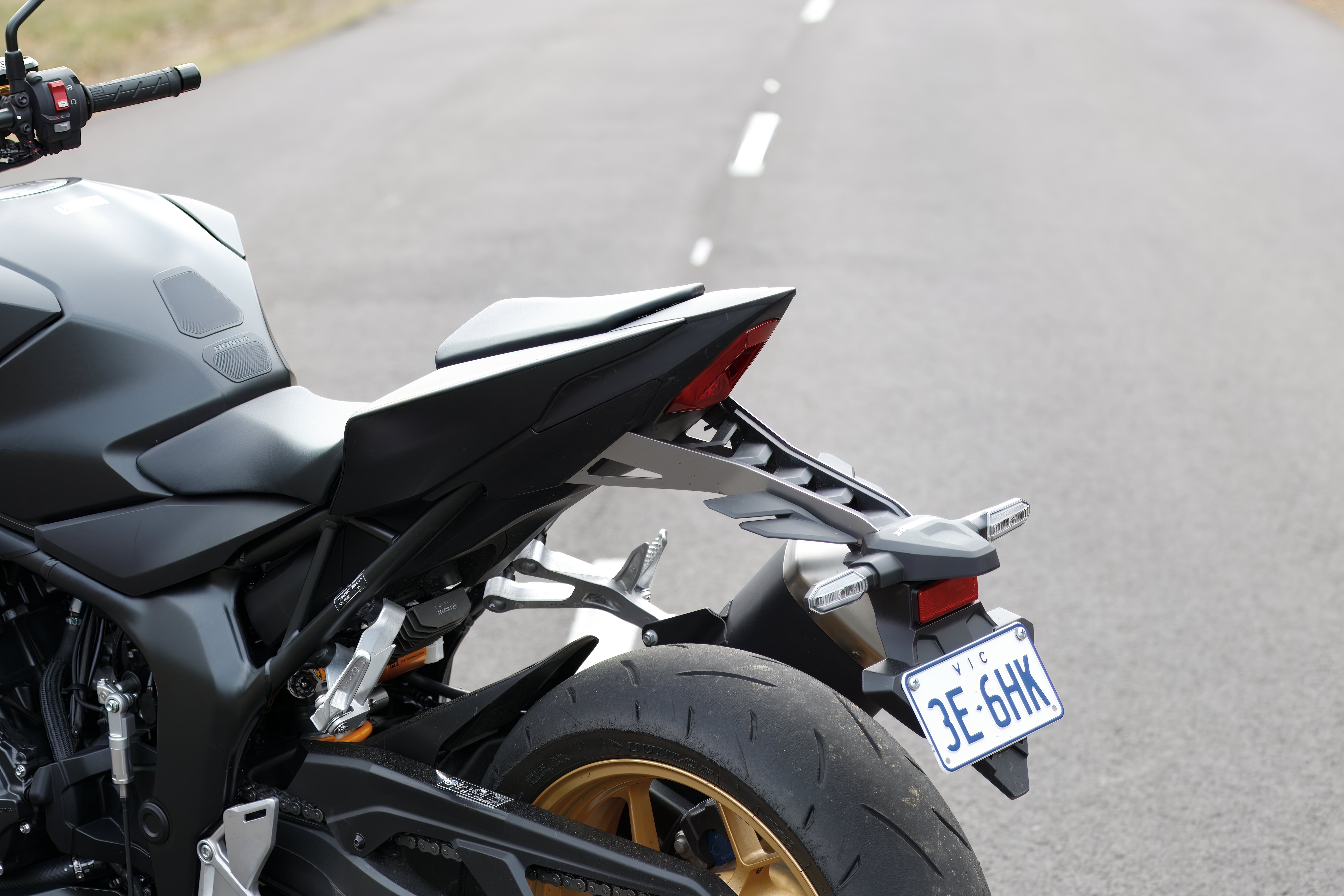
Practicality is better than you might expect. Under the pillion seat there’s space for a small toolkit and a mini compressor, and luggage straps easily to the sturdy pillion ’peg brackets or subframe, and to the sturdy licence-plate hanger. The pillion seat itself is token, but doubles as a platform for a bag. Mirrors are vibe-free but look a bit bland, while the cable-operated clutch lever looks cheap and lacks adjustability. There’s span adjustment on the front brake lever.
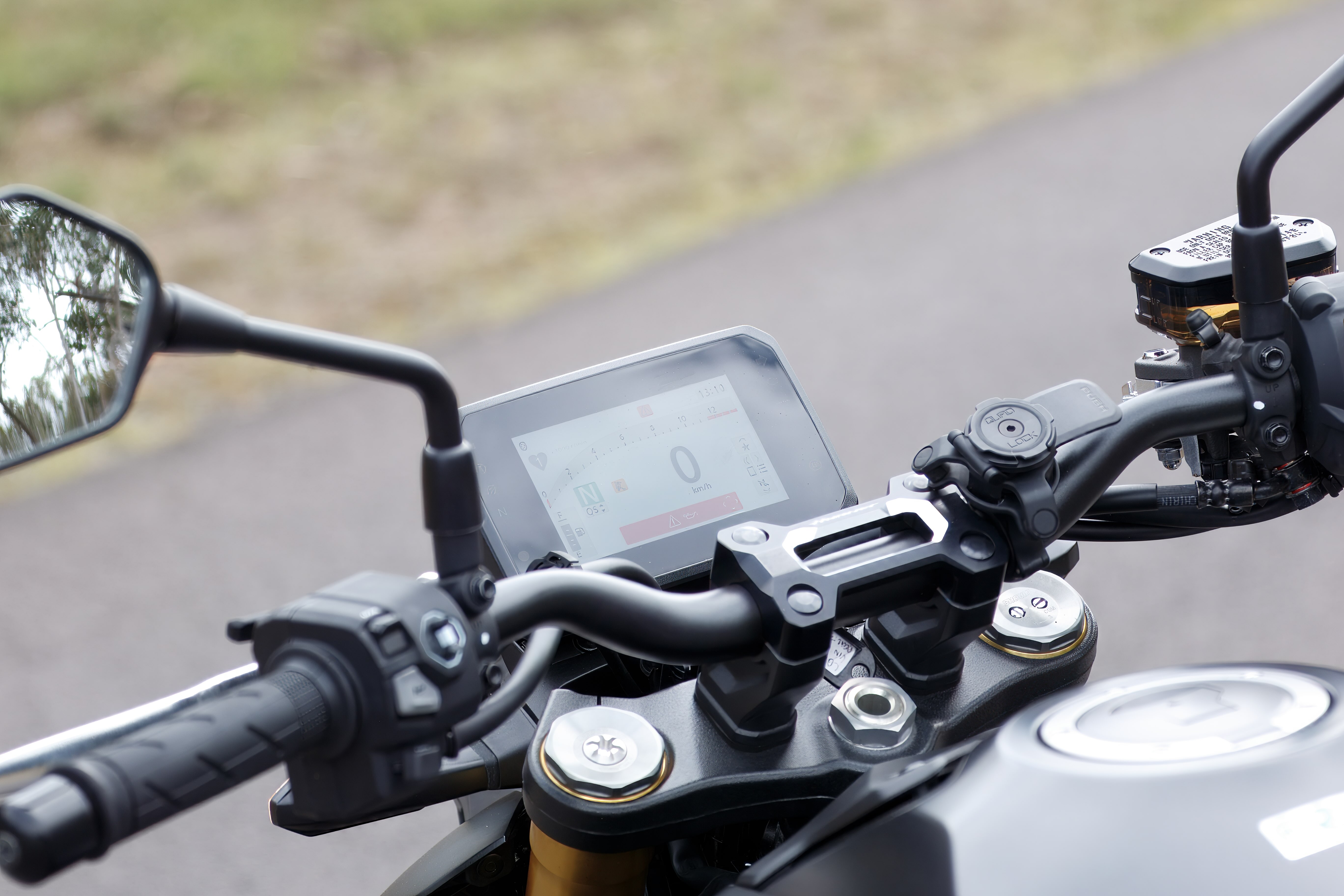
The five-inch TFT is crisp, clear and customisable, with selectable display layouts. Paired with Honda RoadSync, it offers navigation, calls and music via Bluetooth. Once familiar with the backlit four-way toggle on the left switchblock, it’s easy to use. As mentioned, riding modes — Rain, Standard, Sport and two User settings — are selected here too.
The greatest omission of note for road riding is the lack of cruise control, which was sorely missed on the freeway section from Melbourne to Glenrowan in particular. This freeway is littered with speed cameras and it takes just a momentary lapse in concentration to exceed the speed limit on the Hornet SP.
Oh, and heated grips are a $660 option and were not fitted to the test bike.
STYLING & EQUIPMENT
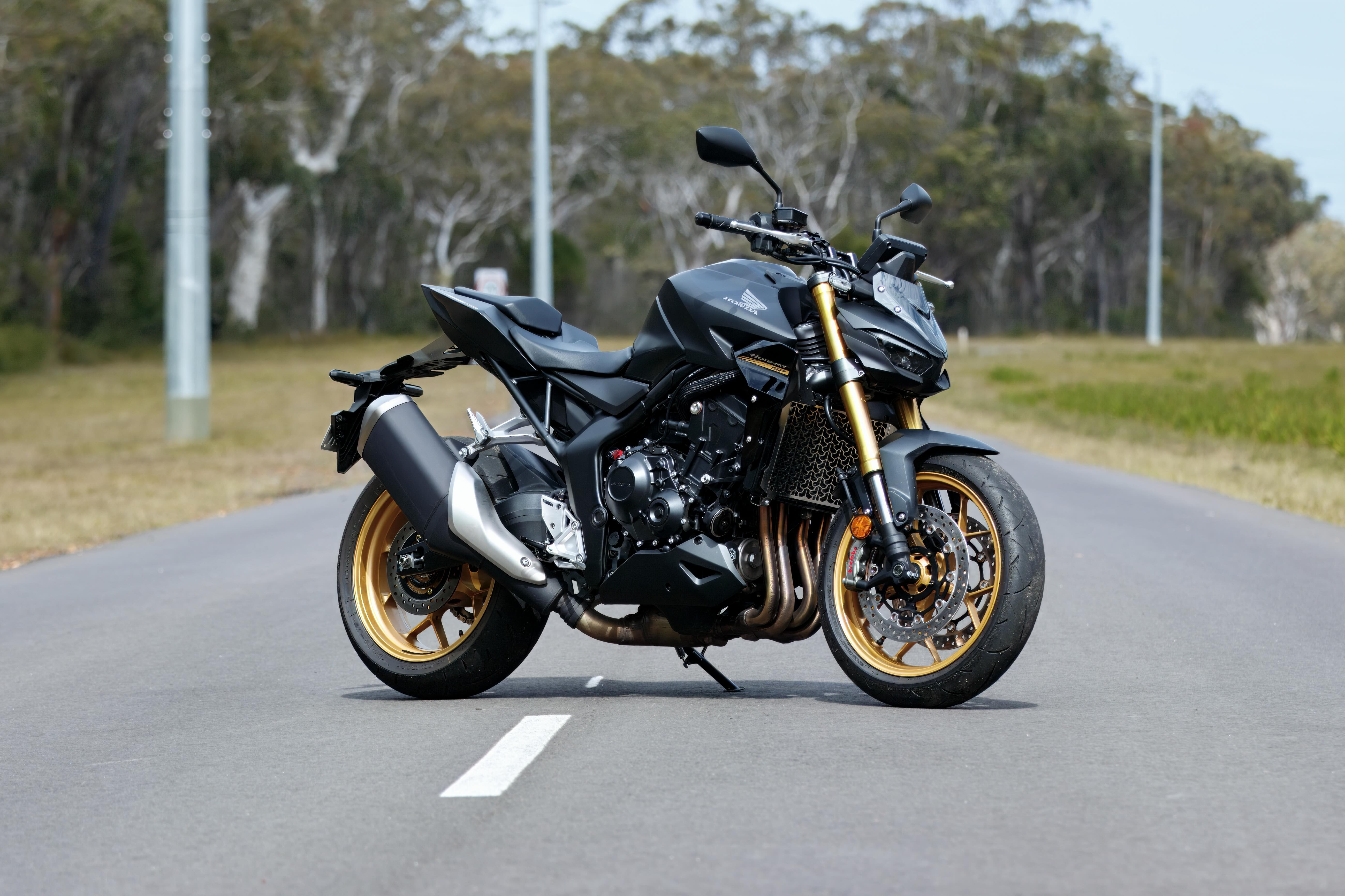
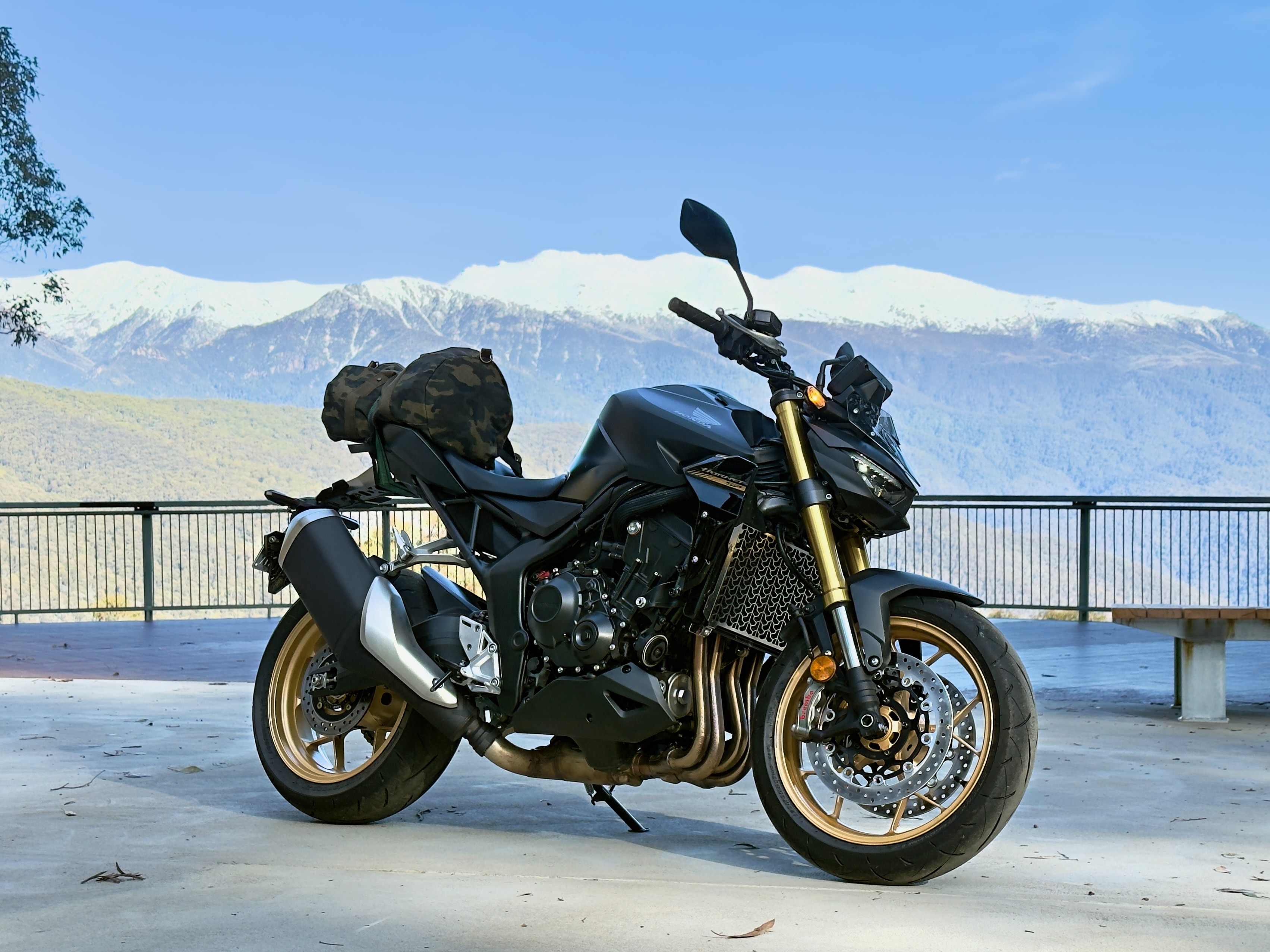
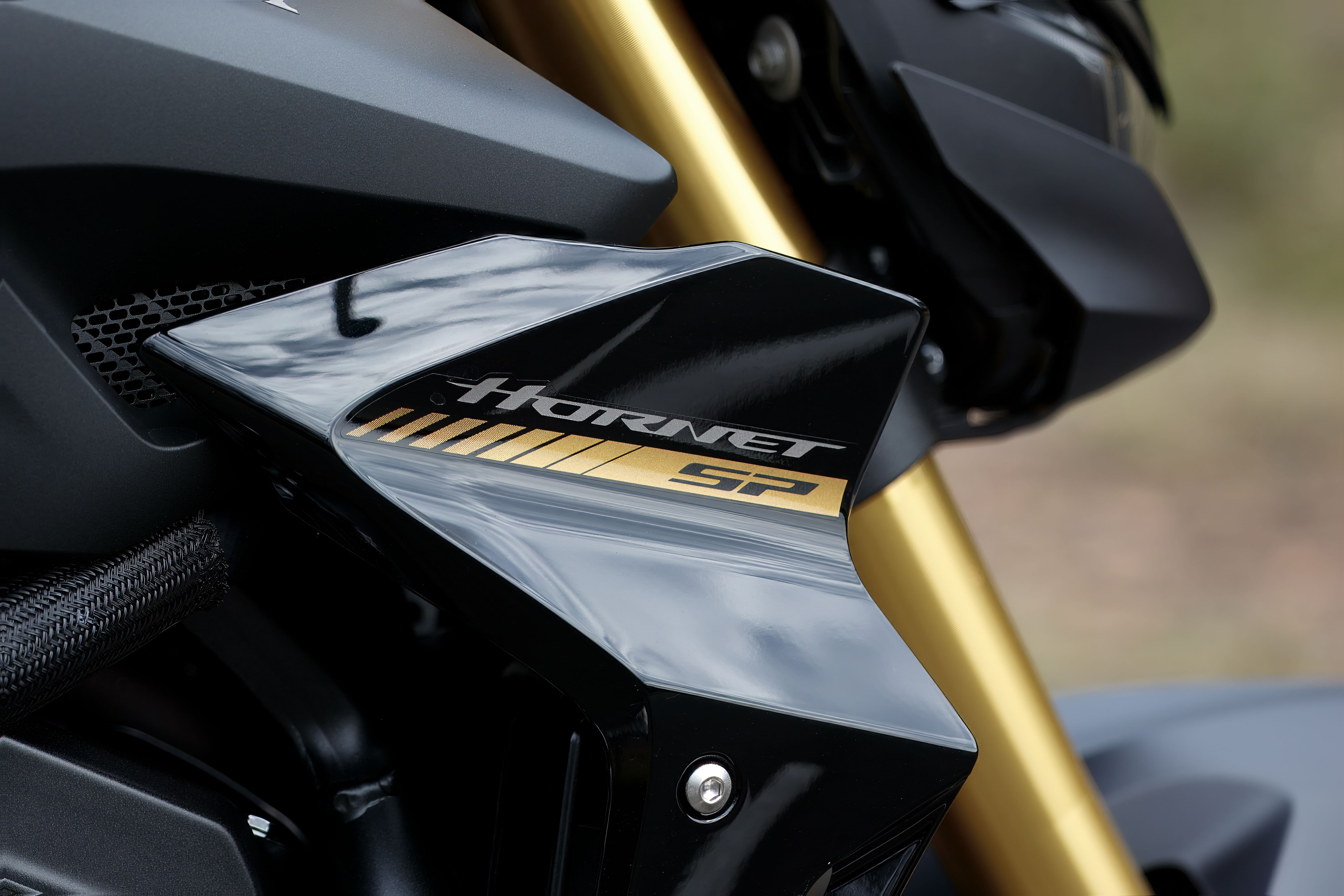
Australia gets just one colour: Mat Ballistic Black Metallic with Desert Gold wheels and gold Showa forks. It looks premium without being gaudy, and it suits the SP’s flagship status, but in dull light it hardly stands out. In full sunlight, however, it pops.
On the styling front, the Hornet has an aggressive stance. The twin LED projectors give the bike a menacing stare by day and strong illumination by night. High beam proved invaluable when dodging kangaroos and wombats on the short dusk run to my overnight accommodation near Adaminiby. The all-LED package also includes indicators with an Emergency Stop Signal (ESS) function that flashes under heavy braking — a good safety feature on the road, though potentially distracting for other riders on track.
The tank is broad-shouldered yet slim at the waist, and is easy to grip with the knees. The steel twin-spar frame is blacked out, while the exposed trellis-style subframe looks great.
Other than the lack of cruise control, equipment levels are generous. Alongside the TFT and rider modes you get the standard quickshifter, HSTC (Honda Selectable Torque Control) with integrated wheelie control, and Honda’s HISS security system. A USB-C port under the pillion seat adds practicality. There are loads of accessories including Alcantara seats, as well as various luggage options. The test bike’s billet ’pegs ($215.20) and black anodised upper handlebar holder ($236.20) gave a quality finish, while the red anodised oil cap ($52.45) and stainless-steel radiator grille ($314.94) looked pretty flash. The test bike was also fitted with a small front visor ($157.45), an under cowl ($577.45) and a tank pad ($62.43).
ON THE ROAD
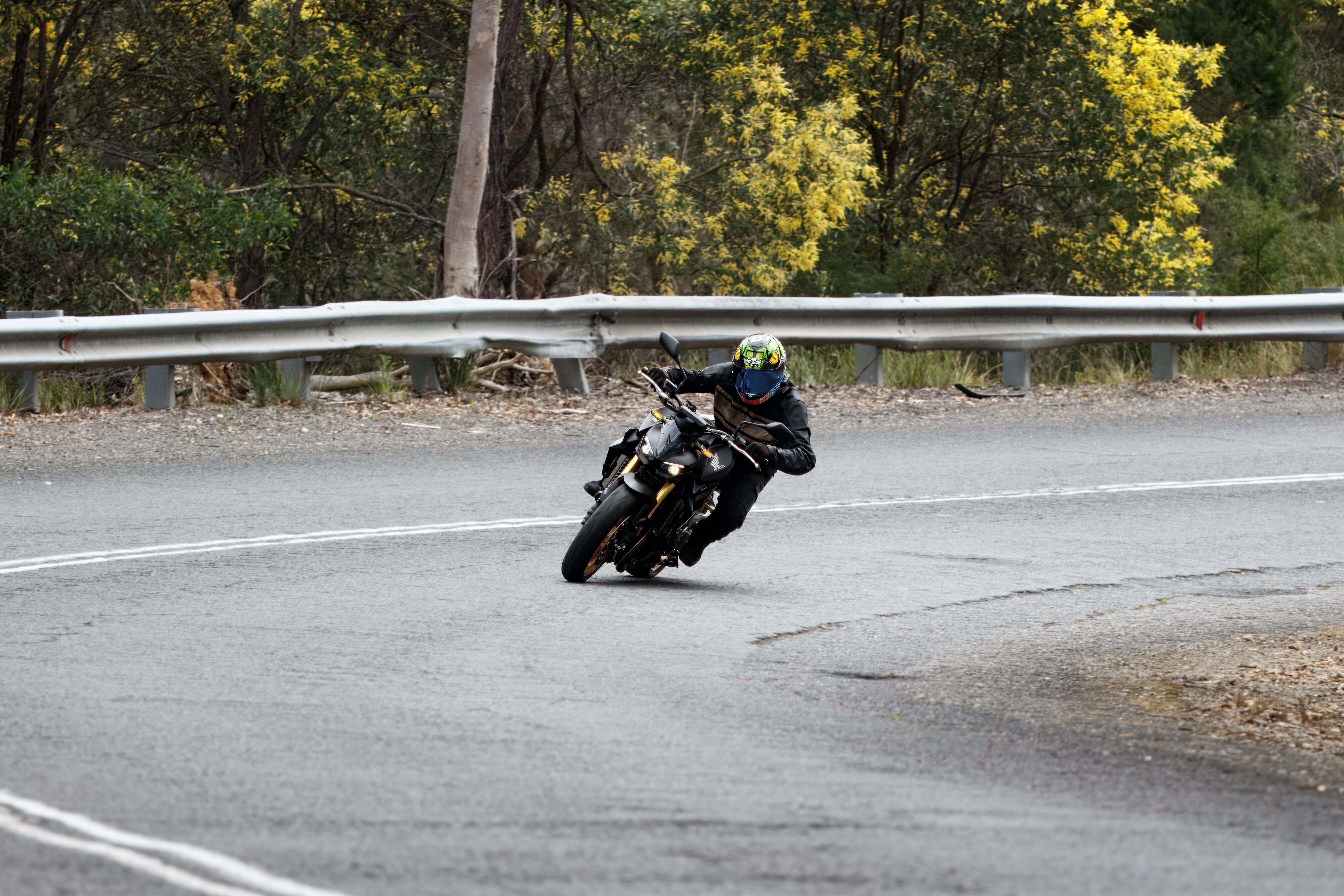
Over two days and 1063km, the Hornet SP proved itself a true all-rounder. From Melbourne to Wollongong via the Alpine Way it was a fantastic companion, on freeway drones, through endless twisties and on bumpy country backroads.
Handling was the standout. The SP darted into corners with middleweight agility, flicking through Alpine switchbacks effortlessly. Once cranked over it stayed planted, the Dunlop Roadsport 2s gripping predictably on smooth and rough surfaces alike. The brakes inspired huge confidence, the front Brembos offering one-finger power and the rear adding useful finesse. When wildlife appeared, the ABS worked seamlessly, pulling the bike down in a straight line without fuss.
The engine made every road a thrill. Tractable in town, with plenty of meat in the midrange and loads of poke at the top — it was just as happy doddling through small towns as it was ripping along open sweepers.
While not its forte, the Hornet SP even proved to be a handy long-distance tourer. Sure, comfort was adequate rather than plush, the seat grew firm after long stints, and the lack of wind protection meant I got pretty cold at times, but the ergonomics, suspension compliance and flexible engine made up for it.
VERDICT
The CB1000 Hornet SP is one of those bikes that feels like more than the sum of its parts. On paper it’s a familiar recipe — detuned superbike engine in nakedbike packaging — but on the road and track it all comes together as a cohesive, thrilling and
practical package.
It isn’t flawless. The clutch lever looks cheap, the mirrors could be off any model Honda and there’s no cruise control… but the rest of the bike is so good that these blemishes can be overlooked.
And at $19,446 plus on-roads, the Hornet SP represents superb value. It’s more polished than Suzuki’s GSX-S1000, cheaper than Yamaha’s MT-10 SP, and undercuts the big-bore European nakeds by a healthy margin.
Honda has built a super-naked that can commute, tour, carve backroads and even cut laps at a trackday — and do each with style.
 ON THE TRACK
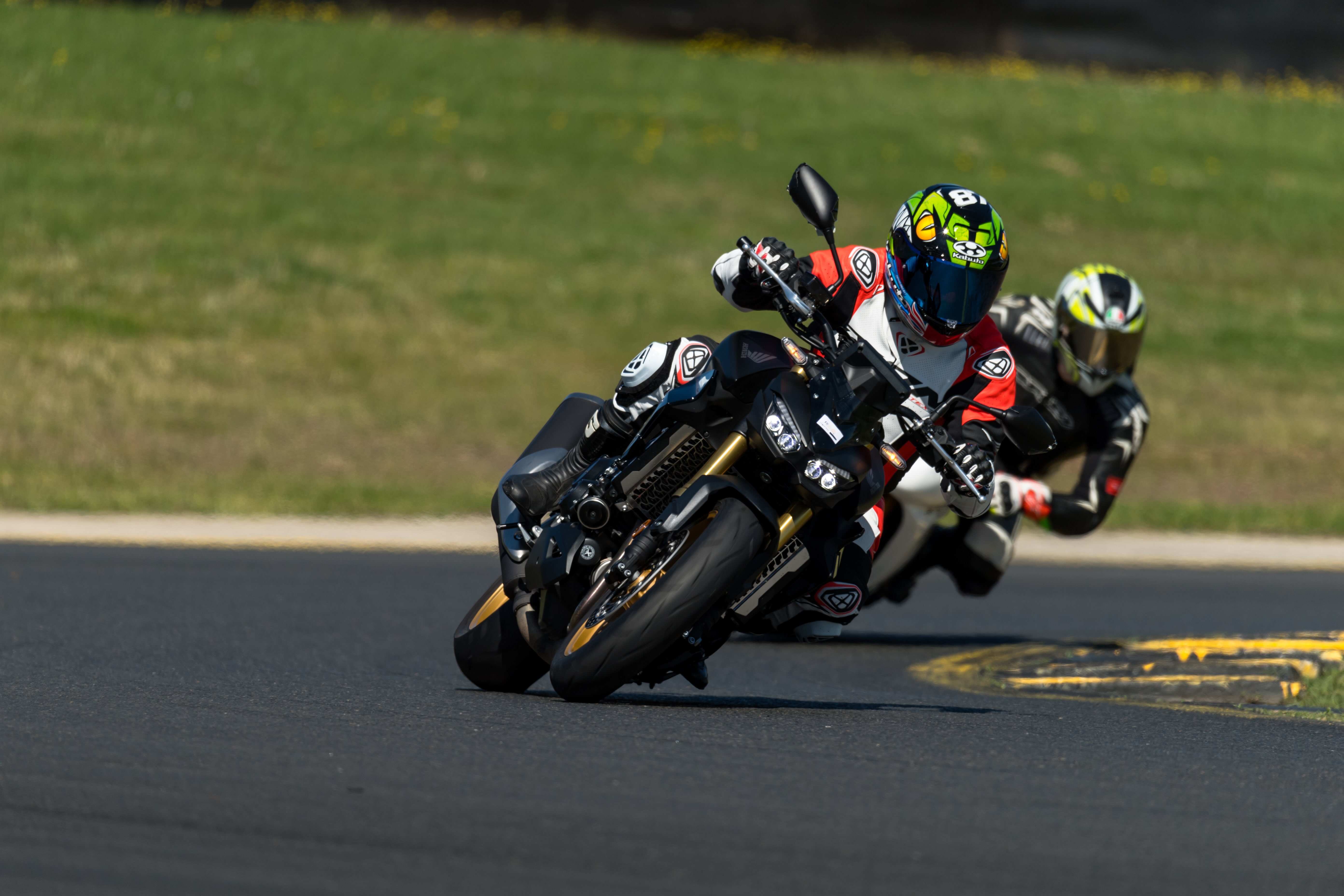
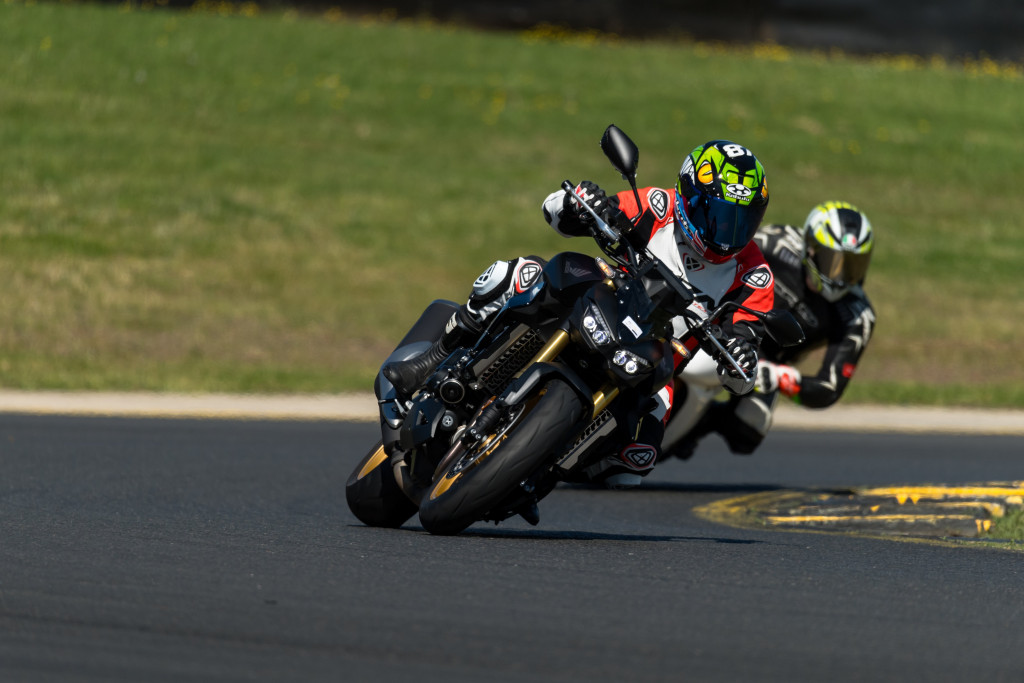
At Sydney Motorsport Park, the Hornet SP showed its sharper side. Steering was the revelation: flickable, predictable and confidence-inspiring, with the geometry giving agility without instability. Through Turn 1 the front stayed planted, through the tighter corners the bike flowed with ease, and only under hard acceleration out of corners did the front feel flighty — a steering damper would be welcome here.
The brakes and suspension proved track-ready. The Showa/Öhlins combo gave excellent control, and the Brembos resisted fade even after repeated heavy braking. Ground clearance was ample, though the long hero knobs scraped early, doing their job of protecting the exhaust.
The engine was sensational. With the RC valve open, the inline four screamed like a superbike, pulling cleanly from the midrange and charging to the limiter. Gearing was spot-on: third covered most of the circuit, second dug the bike out of the hairpin, and fifth and sixth stretched its legs on the main straight. The quickshifter shone here, banging through gears with incredible efficiency.
What impressed most was how approachable the bike felt. Despite the speed it was never intimidating. It simply encouraged smooth inputs and rewarded them with rapid progress. For a naked road bike to feel this composed and capable on track is impressive.
SPECIFICATIONS
ENGINE
Type: Liquid-cooled, 4-stroke DOHC inline four
Displacement: 1000cc
Bore x Stroke:
76.0mm x 55.1mm
Compression Ratio: 11.7:1
Fuel system: PGM-FI electronic fuel injection
Starter: Electric
Ignition: Digital
Transmission: 6-speed, assist/slipper clutch
Final drive: Chain
PERFORMANCE
Claimed maximum power: 115.6kW (155hp) @ 11,000rpm
Claimed maximum torque: 107Nm @ 9000rpm
Fuel consumption (claimed): 5.9L/100km
Fuel consumption (tested): 4.14L/100km
CO₂ emissions (WMTC):
136g/km
CHASSIS
Frame type: Steel twin-spar
Front suspension: Showa 41mm SFF-BP USD fork, fully adjustable, 118mm travel
Rear suspension: Öhlins TTX36 shock, Pro-Link, automatic preload adjustment, 139mm travel
Front brakes: Dual 310mm floating discs, Brembo Stylema 4-piston radial calipers, ABS
Rear brake: Single 240mm disc, Nissin 1-piston caliper, ABS
Front tyre: 120/70-ZR17
Rear tyre: 180/55-ZR17
Wheels: 5-spoke cast aluminium
DIMENSIONS & WEIGHT
Rake/Trail: 25°/98mm
Wheelbase: 1455mm
Seat height: 809mm
Length: 2140mm
Width: 790mm
Height: 1085mm
Ground clearance: 135mm
Turning radius: 2.8m
Kerb weight: 212kg (claimed)
Fuel capacity: 17L
ELECTRONICS, RIDER AIDS & CONVENIENCE FEATURES
TFT display: 5-inch colour, 3 layouts, RoadSync connectivity
Riding modes: Rain, Standard, Sport, 2 x User
Traction control: Honda Selectable Torque Control (HSTC), 4 levels, off option
Wheelie control: Integrated
Quickshifter: Standard, 3-way adjustable, auto-blip
Lighting: Full LED, twin projector headlights, ESS emergency stop signal
USB: Yes
Security: Honda Ignition Security System (HISS)
Price: $19,446 + ORC
Waraanty: 2 years
Service intervals: 10,000km/12 months
Website: Honda CB1000 Hornet SP